Europe’s New Iron Curtain: Research funding awarded to CRCC member Alena Pfoser
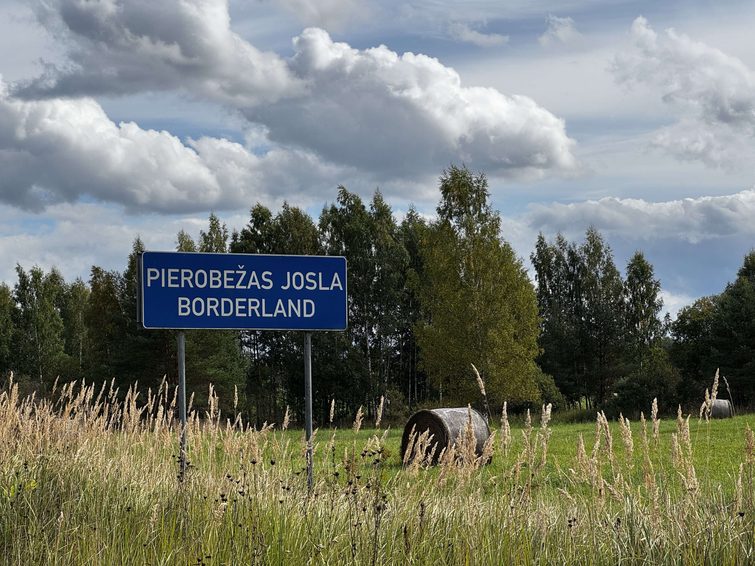
Dr Alena Pfoser, a CRCC member and Reader in Memory and Cultural Studies in Loughborough University’s Department for Communication and Media, has been awarded research funding for a three-year project studying the EU external border with Russia. The project entitled “Europe’s New Iron Curtain: Materiality, Emotion and Memory in the EU’s Eastern Borderland” (£454,700; June 2026-May 2029) is funded by the Foundation for Baltic and East European Studies and conducted jointly together with Dr Florence Fröhlig (PI, Söderntörn University) and Dr Zuzanna Bogumił (Warsaw University).
The project examines the emergence of a new Iron Curtain along the EU’s eastern border, following Russia’s full-scale invasion of Ukraine. Being simultaneously the EU’s external border and NATO’s eastern flank, the borderlands of Poland, Lithuania, Latvia, Estonia and Finland have become a strategically sensitive and volatile frontline zone. Programmes such as East Shield in Poland and the Baltic Defense Line in Lithuania, Latvia and Estonia involve concrete measures to fortify the border through the construction of border fences, metal gates, anti-tank ditches, roadblocks and mined fields as well as investing in drone technology and increased surveillance in order to protect national security interests and defend countries against a possible Russian invasion. This project investigates this border transformation from the perspective of the borderland, shifting the focus away from the geopolitical centres towards the neglected, yet critical margins. It uses mobile and multi-sited ethnographic approach to investigate the changing materiality of the border and how borderland residents, who live in the border’s immediate vicinity, respond to its fortification and securitisation. One key interest is in how collective memories, including histories of past violence, displacement but also past cross-border mobilities shape border practices and perceptions.
The first fieldwork trip was conducted this September and involved travelling along the border in Poland, Lithuania, Latvia and Estonia, conducting site visits to border crossings and border towns and villages including visits to museums and a border guard college. We also spoke to important stakeholders and ‘ordinary’ citizens.
The next stage of the fieldwork, conducted in 2027, will involve in-depth research on border economies, security and ethnic minorities.
If you want to learn more about the project or are interested in a collaboration, please contact Dr Alena Pfoser, A.Pfoser2@lboro.ac.uk
Bio:
Alena Pfoser is a Reader in Memory and Cultural Studies at Loughborough University. Her research focuses on cultural memory, heritage and identity in the transnational arena, focusing particularly on Russia and the former Soviet space. She is the author of Tourism as Memory-Making: Russian Tourism in the Shadow of Empire (Palgrave Macmillan, 2025), based on an ESRC New Investigator Grant project. She currently holds a Mercator Fellowship (2023-2029) at the Leibniz Institute for Research on Society and Space, associated with the Emmy Noether Research Group “The Socio-Spatial Memory of European Borders“.


Centre for Research in Communication and Culture
World-leading media analysis from Loughborough University