Lessons from a London Derby: the UK is doing women’s football right
We’re Céline and Sam, students of Diplomacy and Sport at The Institute for Diplomacy and International Affairs and we went to see Arsenal vs Chelsea at the Emirates Stadium on 8 November. We knew women’s football was growing in the UK, but nothing prepared us for the sight of 56,537 fans filling the stadium. For a sport that has for so long sat in the shadow of its men’s version, the sight felt like a quiet revolution in real time. The atmosphere struck us instantly. Families everywhere, countless young girls wearing shirts with their favourite players’ names, even a baby bouncing on the seat in front of us.

No tension, no aggression… just people who love the game. It reminded us that, at the end of the day, football is joy. It can shape your identity and give you a community, but it remains a game meant to bring people together. Next to us in the away end sat Nick, a proud Chelsea supporter who led chants throughout the match. We spoke briefly, and he told us that he comes to women’s games because he enjoys the atmosphere and men’s matches have become too expensive. It made sense: accessibility is part of this boom. Women’s football in the UK has become a space where fans feel welcome, families can afford to come, and the sport feels closer to its roots.
Céline’s take
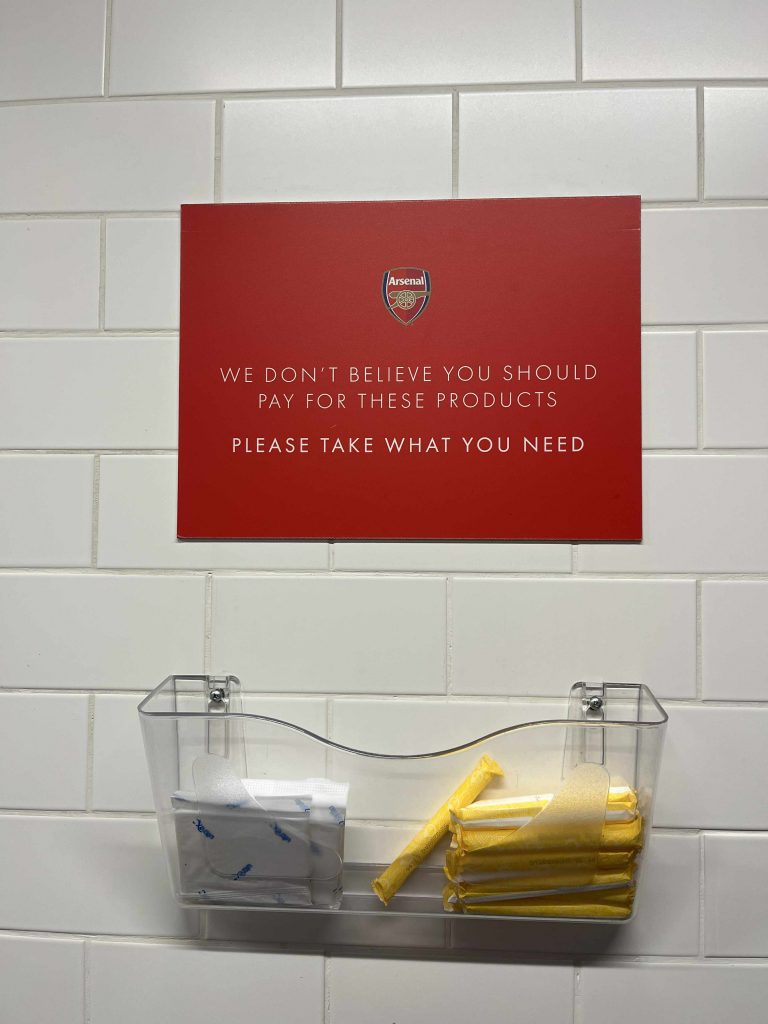
Coming from Belgium, the contrast is stark. When I went to watch RSC Anderlecht Women, the ticket was free… yet the stadium was still far from full. Football back home remains deeply coded as masculine. The UK shows how quickly narratives can change when a country invests seriously in women’s football: financially, structurally, and culturally. The Lionesses are a powerful illustration of this dynamic: their success has encouraged more young girls to start playing football, which in turn has attracted more investment into the women’s game. Countries that fund girls’ football at grassroots level gain a long-term competitive advantage internationally. One detail stuck with me in the stadium toilets: free period products, laid out casually, like it was the most normal thing. Small gesture, huge message. It says women are not guests here, they belong.
I have followed women’s football in the UK for a while now. British clubs put effort into storytelling, marketing, and social media. Yet even in the UK, some details show how far equality still has to go. One example that always bothers me: social media naming. The men’s team is “Arsenal”, full stop. The women’s side becomes “Arsenal WFC”. Same for Chelsea: “Chelsea FC” vs “Chelsea FCW”. If one team needs a gender marker, shouldn’t the other? Otherwise, we keep reinforcing the idea that the default is male, and that women’s football sits in a secondary lane. Small choices in language reveal bigger cultural hierarchies.
Sam’s perspective
Chelsea’s opening goal in this thrilling 1-1 draw at the Emirates was a brilliant chip from American starlet Alyssa Thompson. As an American and passionate US Women’s National Team (USWNT) supporter, this was my favourite moment of the match.
Back home in the United States, the women’s football landscape has always been unique – unlike most of the world, all National Women’s Soccer League (NWSL) franchises operate separately from men’s football clubs, making social media naming less of an issue and allowing modern, independent club identities to blossom. I’ve attended several Washington Spirit matches, all with sold-out, engaged crowds – Audi Field is nicknamed ‘Rowdy Audi’ for a reason.
However, the 20,000-seat capacity there felt nothing like the spectacle I saw at the Emirates. The NWSL is still the highest-rated women’s football league in the world, but none of its fixtures offer the tradition and crowd size a London derby brings. This, along with higher salaries, has lured American players across the ocean. – Saturday’s match featured three of them, with Arsenal’s Emily Fox defending against Chelsea forwards Catarina Macario and Thompson.
As the NWSL and WSL continue to compete for the world’s top talent against a backdrop of meteoric growth in women’s football, it will be fascinating to see how the next decade unfolds. Will “traditional” clubs in a country – the UK – with deep-rooted football culture be the most attractive model for fans and players? Or will it be original brands in the USA? It is also worth the NWSL’s league-wide player salary cap; while this is a staple of American sports leagues to promote competitive balance, it gives the WSL the upper hand in international transfer negotiations.
Conclusion
Walking out of the Emirates, buzzing from the noise and the joy inside, we felt genuinely hopeful. The U.K. has shown what is possible when women’s football is given space to grow. We are already planning to be at the return game at Stamford Bridge in January. Other countries now face a choice. They can wait for the sport to grow on its own, or they can invest, promote and celebrate it the way the UK has. If there is one conclusion to draw from 56,537 people in North London, it is this: the future of football is not male or female – it is whoever fills the stadium.

A big thank you to Céline and Sam for writing this blog!


Loughborough University London
Blogging everything that’s happening at Loughborough University London