FLUX 2025 -What does designing with the More than self entail?
“There is something incredibly charming hearing people you know in another body’s experience — their takeaways from encounters with other species.” This reflection from Ruth Catlow captures most viscerally the spirit of FLUX 2025: More than self, held on 17 June 2025 by the Institute for Creative Futures at Loughborough University London.
The day-long event brought together students, practitioners, and researchers from across the arts, design, and academia, interweaving a student exhibition, a soundscape workshop, a panel discussion with Angela YT Chan, Christie Swallow, Dr Spyros Bofylatos, and Harun Morrison, and a presentation by Ruth Catlow in conversation with Dr Viktor Bedö. The symposium was chaired and organised by Dr Pandora Syperek and Dr Ksenija Kuzmina, with assistance by Ania Mokrzycka and in collaboration with the Flux25 Organising Committee.
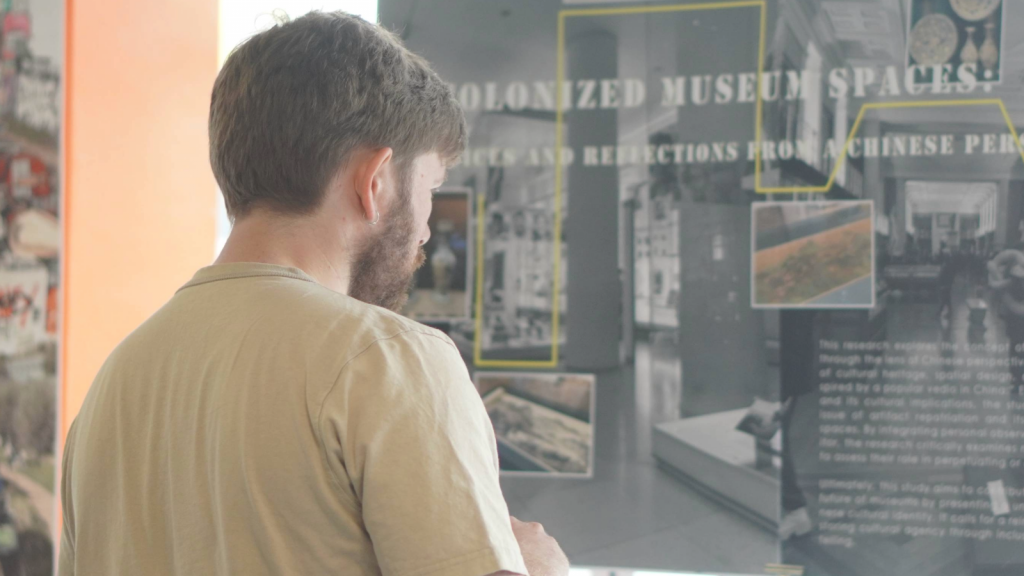
Framed by critical questions of subjectivity, agency, and empathy, the symposium asked how we might attend to radical otherness across species, technologies, and ecologies, while acknowledging the social inequalities and uneven histories that shape these entanglements. The presentations showed how engaging with data, stories, and sensory methods can deepen insights about the complexities that bind human and beyond-human worlds. We learned how role-play might help us imagine new forms of justice, what species like parakeets or the Jamaican Swallowtail Butterfly can teach us about belonging — and non-belonging — and how our desire to care across multiple worlds often collides with uneven knowledge and responsibility.
More-than-human Encounters & Citizens across Species
Through their projects, each speaker foregrounded the ethical and political stakes of more-than-human coexistence.
In her talk,artist and climate researcher Angela YT Chan presented her work examining how technology and climate justice intertwine in discourses of climate change. Projects like Forestscapes collected soundscapes across multiple geographies and seasons to engage collectives of people in forest ecologies, their issues and restoration efforts, while the Weathered Radio workshops recorded sensory experiences about changing political and natural climates. In discussing her engagements with public narratives around the UK’s net-zero strategy, Chan emphasised the importance of documenting such futurings that contribute to normalising green militarism, framing war as compatible with sustainability.
Artist Harun Morrison further thematised the political stakes of ecological interventions by tackling the controversial efforts to reintroduce the endangered Jamaican Swallowtail Butterfly in the Dolphin Head Mountain, a land used for bauxite mining that significantly altered the butterfly’s habitats. Drawing on archival materials from the Horniman Museum’s Natural History Gallery — including a 1972 handbook titled Defences of Animals — Morrison’s 2023 exhibition Dolphin Head Mountain, conceived as a shifting display, combined sound and performance to prompt reflection on how museum collections preserve and mediate knowledge.
In a parallel enquiry, artist and designer Christie Swallow investigated urban parakeets as both historical actors and fellow city-dwellers, developing Paracologies as a lens for studying interspecies relationships, their environments and shared ecologies. The project traced the parakeets’ ancient lineage through their ties to places and their coevolution alongside humans across urban habitats, challenging origin stories that essentialise species or marginalise non-Western and Indigenous epistemologies, and prompting reflection on what it means for a species to be considered “native” to a place.
Dr Spyros Bofylatos also emphasised the importance of place, noting that places “feed into our practices”. Speaking directly to the design community, he discussed how autoethnographic practice can help designers harness intuition and inspiration to build their practice while engaging in rigorous introspection. Through projects that used reflexivity to understand place and developed protocols that weave in multi-layered sensory experiences —capturing material encounters, for instance, by asking engineers to write haikus about bioplastics made from food waste — Bofylatos showed how such methods can inspire new vocabularies of material engagement.
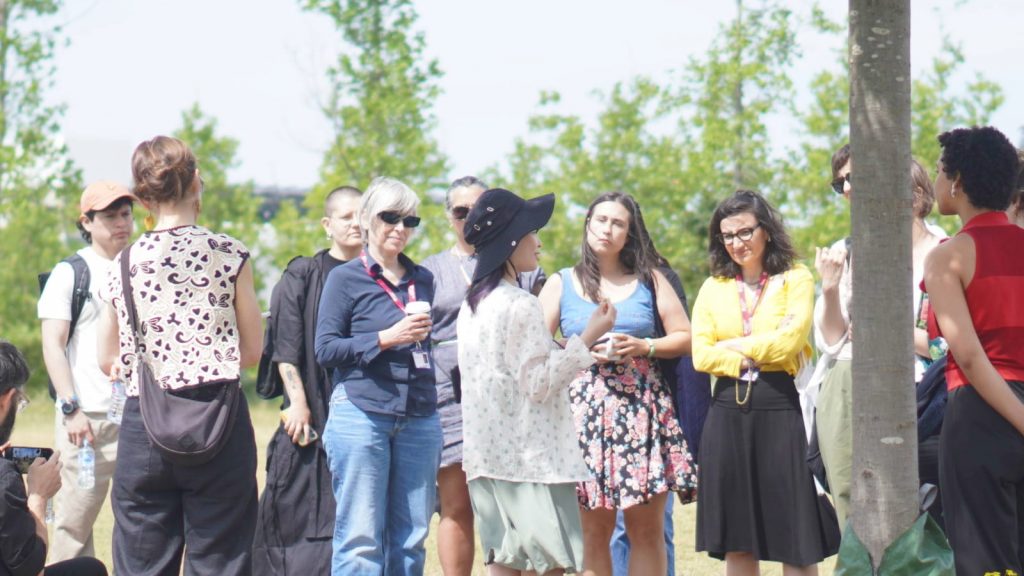
UK-based artist, researcher and organiser, Ruth Catlow introduced Furtherfield, the initiative she cofounded and has been fostering commoning cultures and advancing more-than-human interests at the intersection of art, technology, and eco-social change. This vision guided also her work on The Treaty of Finsbury Park that used multispecies Live Action Role Play (LARP) to promote “interspecies democracy” within the context of London’s Finsbury Park, a site marked by pollution, traffic, and ongoing financial pressures. Conceived as a future-facing event, The Treaty gathered a delegation of park residents — including rangers, managers, everyday users and nonhuman stakeholders from grass to geese to stag beetles — to strike a shared agreement in protecting their habitat. Through online and live role-playing, participants stepped into the world of other species to reflect on how colonial domination, institutional structures and governance systems shape urban parks and their biodiversity.
Collectively, the presentations gestured toward articulating the interfaces between humans and other-than-humans where play and experimentation negotiate differences towards more ecological citizenship and democratic futures.
Entanglement, Multitudes & Subjectivity
In exploring interspecies communication, the projects tackled processes of emergence, mediation, and experiences that transform subjectivities. While converging on challenging unity, identity, and atomism, each speaker sharpened a different methodological edge that brought us closer to one of the key questions posed by the symposium:
“Where are the boundaries between the individual and the other-than-human, when we are porous and entangled bodies, each containing multitudes?”
The term multitude here highlights the multiplicity of living agents that create shared worlds. Originally drawing from political philosophy,[1] multitude describes a collective defined not by shared identity but by common modes of existence and relational agency. In multispecies contexts, the concept underscores how bodies, environments, and ecologies are made up of interconnected lives, each with their own agencies and knowledges.
Such entanglements are at the core of Paracologies, where Christie Swallow sought a deeper understanding of human-nature relationships and coexistence, while also problematising how bodies perform knowledge and shape how others come to belong within allegedly artificial ecologies and postcolonial landscapes. By staging a sensory exchange that convened humans and parakeets in close yet distinct ways, Swallow invited participants to think in solidarity with so-called invasive species like parakeets.
Extending this reflection, Harun Morrison questioned not only how we communicate with other species, but also to what end, and who benefits from cultivating sensitivities and ways of thinking across species. He cautioned that in seeking understanding there is a risk of reproducing the intrusive gaze of past naturalists, who probed animal lives more out of control than curiosity. As a counterpoint, Morrison’s metaphor of the Telepathic Butterfly invites respect for the unknown within nature and animal worlds, resisting colonial categorisations and Western taxonomies embedded in the museum collections, and allowing certain boundaries between species to remain.
This sense of accountability for embodied knowledge also resonates with the relational and historical approach Angela YT Chan adopts to guide the collection, processing, and mobilisation of data for climate justice. Forestscapes extends this sensibility through its use of sound to expand the boundaries of listening and narrate affective encounters and shared understandings of forest ecologies.
Moving towards ecological justice, Ruth Catlow suggests, involves embracing “what feels lively as well as what feels deeply uncomfortable”, as demonstrated in The Treaty of Finsbury Park. By tracing how local choices connect to global systems and how situated knowledge shapes urban habitats, the project shows that caring for small patches of urban biodiversity can inspire imaginaries of more equitable coexistence.
In practising conversing across species, these more-than-human encounters highlight the power dynamics at play, but they also enrich experiential skills to nurture these ecologies in which humans are nested in dense networks of connections as part of larger multispecies collectives.
Auto-theory, Liberation, Radical Otherness & Inequality
While inviting us to see life as plural and evolving through shared encounters, the projects also turn our attention inward to reflect on further provocations posed by the symposium:
“How do we look inward to look outward, navigating the terrain of the self without succumbing to navel-gazing? What potential does auto-theory present for collective and multispecies liberation? And which methods can bring a focus to the radical otherness of species difference without sidelining social marginalisation and inequality?”
In responding to these questions, the projects grapple with what Dr Spyros Bofylatos describes as “what matters but cannot be measured or explained”. They foreground tacit knowledge — the contextual skills and sensitivities key for navigating uncertainty — and articulate practices that expose the material and intersubjective dimensions of creative process, including the relational and socially mediated nature of inspiration itself.
Across the projects, sensory and participatory practices offer alternative ways of engaging with complexity and data, moving from introspection toward a relational and historical understanding of selfhood.
For example, Forestscapes activates climate datasets through affective and imaginative registers bycollecting sound-based narratives from field recordings, curating playlists, and encouraging collective listening. These methods honour the autonomy of the forest “other” while highlighting the social dimensions of climate justice embedded in the data and generating insights that speak to both expert communities and broader publics. Where Chan repositions data collection through storytelling for public engagement with forest ecologies, Morrison blends fiction with archival research to interrogate the museum collection. Sound and performance animate the endangered butterfly with its own histories, vulnerabilities, and agency, extending tacit knowledge across species while signalling the limits of human understanding of more-than-human consciousness.
In Swallow’s Paracologies, quilting allows a tactile and reflective way of layering information by stitching archival materials into textiles that are carried on walks and used to connect humans directly with parakeets. This intention is amplified through musical performances inspired by the song of London’s ring-necked parakeets and sung by humans. It demonstrates how creating “moments of first contact” with “othered” species can foster proximity and empathy, similarly to role-play in Catlow’s The Treaty of Finsbury Park, where participants took on characters to navigate other-than-human perspectives, negotiate interests, and improvise responses to the needs and attachments of these species.
The projects position us within the historical trajectories of multispecies justice to guide collective decision-making and enacting alternative futures. For instance, The Treaty’s Interspecies Cooperation sentience dial — a fictional device helping humans connect with their nonhuman counterparts — invited participants to pledge a cooperation pact among all living beings and imagine a future where all Finsbury Park inhabitants share equal rights. In aligning with Chan’s relational approach to climate justice, methods of listening and narrating emphasise human agency that sustains ecological awareness within broader environmental and social histories. Likewise, efforts to save the endangered Swallowtail Butterfly, whose habitat has been disrupted by extractive industries, illustrate how conservation decisions often compensate for the technological reworkings of landscapes that undermine any vision of multispecies liberation.
More than self implications for Design Practice
The concept of the more-than-selfcallsfor a radical rethinking of human agency participating in collectivity beyond the individual gaze. In the arts, this perspective has shaped participatory, community-based, and socially engaged approaches that prioritise relations and collaborative experimentation over singular artistic intention.
The projects staged at FLUX 2025 extend this ethos towards interspecies cooperation and coexistence. At their core lies a commitment to the hopeful possibilities Donna Haraway describes as the “time place for learning to stay with the trouble of living and dying in response-ability on a damaged earth”.[2] In this context, relational awareness decentres the self to attend to forms of agency often overlooked. By moving beyond anthropocentric thinking and addressing ecological restorations entwined with colonial histories, the projects extend tacit knowledge in multispecies perspectives to guide critical enquiry into human positionality and relational responsibility.
This outward attention to nonhuman agencies shapes the language and medium of embodied self-reflection. Visuality, sound, performance, quilting, music, and acting enable sensory methodologies for thinking with the self, yet also beyond the self by situating creativity within — but not limited to — human experience. Curating and collectively listening to forest soundscapes, as well as composing and singing a parakeets-inspired song, create language that, in Karen Barad’s terms, transcends the human-nonhuman binary. Moving from merely representing to enacting, methods such as listening, sensing, and improvising, invite affective engagement and situated narratives that unsettle the boundaries of the individual and anchor agency in favour of more-than-human interests.
At the same time, working within the limits of a medium (such as sound) draws attention to the limits of translation and the dangers of abstraction. Chan illustrates this by reflecting on the challenge of integrating two types of forest environments into a narrative soundscape without blending them into an abstract whole. While attending to difference re-sensitise our perceptions, the pursuit of clarity, she suggests, mirrors the human desire “to find answers because uncertainty is hard to sit with” — the same impulse that makes the seemingly straightforward path to net-zero appear reassuring, even when such certainty conceals troubling power dynamics.
Each project intervenes in this tendency to seek solutions in fixed answers. Moving across genres, disciplines, and languages, they engage the ambiguities of ecological transformation and relational justice in search of a shared vocabulary for collective stewardship across species. Yet this ethical imagination demands a richer language to describe individual and collective processes of becoming and the values they generate. It calls for cross-disciplinary engagements within institutional structures that still privilege measurable outcomes over accountability for the public narratives they sustain. It urges better understanding of the systems and bodies — civic, public, nonprofit, or individual — responsible for caring for more-than-human ecologies. It situates selfhood within broader multispecies ecosystems, refining auto-theories of practice through more rigorous introspection.
In this context, the radical openness in the more-than-self becomes meaningful only when we recognise that change also relies on our capacities to integrate and adapt over time. While attuned to designing amid the troubles we perpetuate, the quieter lesson of the Telepathic Butterfly reminds us that learning to find ease in uncertainty may itself be an ethical gesture of care.
Written by Noémi Zajzon
[1] Most notably from the work of Spinoza, and later Michael Hardt and Antonio Negri. The term also refers to the phrase “I contain multitudes” from Walt Whitman’s 1892 poem “Song of Myself”, which explores the potential for communion between individuals and inspired the title of science writer Ed Yong’s book on the role of the complex ecosystems of microbes in human and nonhuman bodies (Ed Yong, I Contain Multitudes: The Microbes Within Us and a Grander View of Life. Ecco, 2016).
[2] Haraway, D.J., 2020. Staying with the trouble: Making kin in the Chthulucene. Duke University Press, p.2.


Loughborough University London
Blogging everything that’s happening at Loughborough University London