80 Years of the United Nations General Assembly: IDIA Students at a Historic UNGA Commemoration
Written by Rashane Jude Pintoe (Student of MSc Peace-building, Security and Diplomacy)
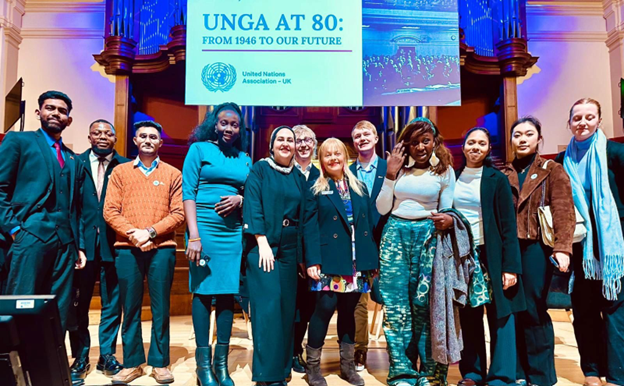
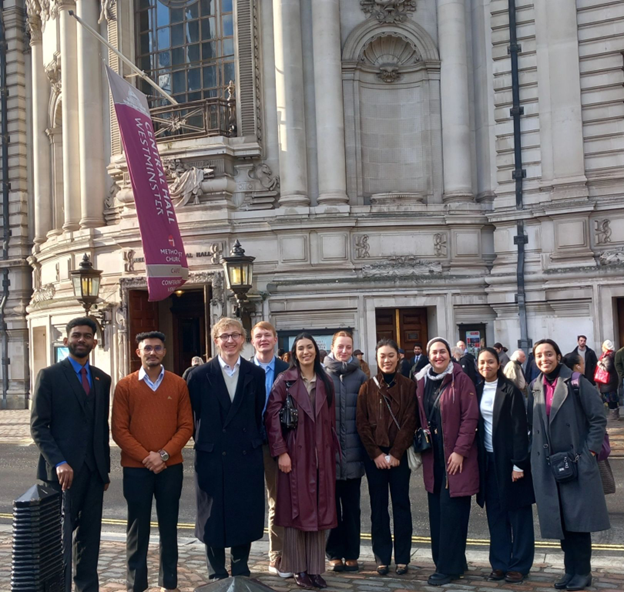
In January 1946, in a world picking itself up from the scourge of the Second World War, the leaders of that generation convened at Central Hall Westminster London in search of permanent peace – forming the United Nations. Eighty years later in January 2026, accompanied by faculty, eleven students from the Institute for Diplomacy and International Affairs (IDIA), attended the 80th year commemoration of that very pledge at the very same Central Hall Westminster.
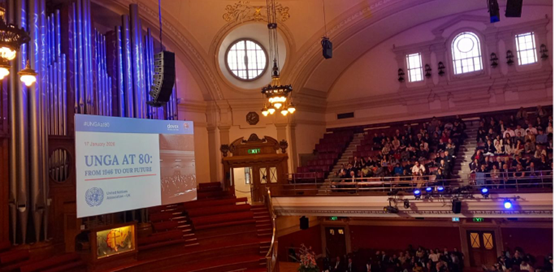
The event, ‘UNGA at 80: From 1946 to Our Future’, organised by the United Nations Association UK, was both a privilege and a powerful reminder of history’s weight on the present. With keynote contributions from the UN Secretary-General, the President of the UN General Assembly and the UK Attorney General, and several panel discussions with prominent personalities, the event stood out as a rare high-level gathering at the intersection of global diplomacy, international law and multilateral governance.
The event offered a particular opportunity to reflect not only on the origins of the UN, but also on its relevance at a time when the rules-based international system appears increasingly threatened by several actors. Eighty years ago, the UN General Assembly emerged as a forum grounded in collective security, in the hopes of upholding international law with cooperation amongst nation states. That very vision echoed throughout the afternoon – yet it was difficult to ignore how distant that message of optimism felt given the status quo.
From multiple conflicts across the globe, to various norms being selectively applied, the trust between allies becoming increasingly fragile and renewed scepticism toward international institutions and collective commitments, the event felt less like a celebration and more like a moment of reckoning. UN Secretary-General António Guterres captured this tension clearly in his address. He emphasised that multilateralism is not an abstract ideal but a practical necessity. The strain on alliances and the transactional approach increasingly visible in global diplomacy raise uncomfortable questions about whether the rules-based international order can endure without consistent leadership from its architects. Against this backdrop, the Secretary General’s defence of international law and cooperative problem-solving felt less ceremonial and more urgent.
Annalena Baerbock, the former German Foreign Minister and current President of the UN General Assembly, built on this theme by touching on the Assembly’s foundational purpose – to serve as a space where all states can voice concerns and shape global norms regardless of their power and influence. Her speech also highlighted the dangers posed when major powers bypass or undermine it. In an era where unilateralism often appears expedient, her message was a reminder that legitimacy in global governance is derived not from power alone but from participation and consent.
The UK Attorney General, Lord Hermer KC, made his speech’s message firmly in the language and principles of international law, returning repeatedly to the UN Charter as a living document rather than a historical artefact. He spoke of how the Charter’s commitment to collective security, peaceful dispute resolution and legal restraint remains essential in an era marked by power politics and selective rule breaking. Particularly striking was his warning that when international law is treated as optional rather than binding, it is not only institutions that suffer, but the stability and predictability of the entire international system.
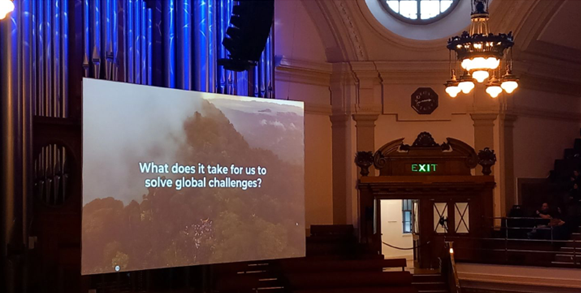
Another profound speaker came from outside the traditional diplomatic circle. Prominent astrophysicist Professor Brian Cox made an address that offered a broader and humbling perspective to the matters at hand. His placing of the issues of humanity as a mere blip in the larger existence of the universe brought strong perspective on why unity and peace are essential when looking at the grander scheme of things. This did not diminish the seriousness of global challenges but rather reframed them. If humanity occupies such a small window in time and space, then peace and collective survival become not just moral choices, but rational ones.
The perspectives of the speakers lingered long after the event concluded. The troubles facing the world today – fractured alliances, weakened institutions, and growing mistrust – are significant, but they are not immutable. The UN itself was born in a moment of profound crisis, when cooperation seemed improbable. That it has endured for eighty years, however imperfectly, is testament to the enduring appeal of multilateral solutions.
Leaving Central Hall Westminster, it was difficult for Loughborough students and all other guests not to reflect on the symbolism of place and time. The same walls that once hosted the hopeful beginnings of the UN now hosted a conversation about its uncertain future. Whether the next decades are defined by fragmentation or renewed cooperation remains an open question. Yet events like ‘UNGA at 80’ serve as a reminder that the principles of unity and collective responsibility are not relics of the past – they remain essential guides for navigating an increasingly complex world.
The Institute for Diplomacy and International Affairs (IDIA) offers master’s and doctoral programmes designed to meet the evolving demands of today’s world. At IDIA, we work alongside our students to provide them with the essential tools to comprehend these global realities, preparing them for diverse careers in both public and private sectors across the globe. Check out our programmes and apply to study with us here.


Loughborough University London
Blogging everything that’s happening at Loughborough University London