Reflections from Canada House: Measuring Sport’s Contribution to the SDGs
Written by Céline Erciyas (Student of MSc Diplomacy and Sport)
The Institute for Diplomacy and International Affairs (IDIA) offers master’s and doctoral programmes designed to meet the evolving demands of today’s world. At IDIA, we work alongside our students to provide them with the essential tools to comprehend these global realities, preparing them for diverse careers in both public and private sectors across the globe. Check out our programmes and apply to study with us here.
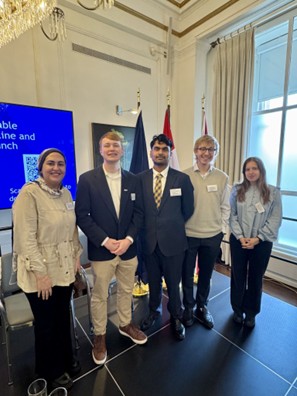
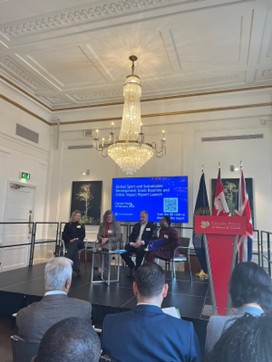
Opening remarks by Simon Collard-Wexler, Minister-Counsellor at the High Commission of Canada, set a clear political tone. Framing the report as a “call to action”, he emphasised Canada’s belief in sport as a means of building community and cooperation across the Commonwealth. With major sporting events on the horizon (Glasgow 2026 Commonwealth Games, FIFA World Cup), sport was presented as a platform for positive societal change rather than simply competition.
Dr Arjoon Suddhoo, Deputy Secretary-General of the Commonwealth, addressed a long-standing challenge: while sport’s contribution to the SDGs is widely acknowledged, it has remained difficult to measure. The report responds to this gap by delivering a first-ever global baseline, using data from across every country to evaluate the contribution of sport and physical activity against the SDGs. Importantly, the report is framed not as an endpoint, but as a starting point to guide future action, partnerships, and policy learning.
Panel discussion: from measurement to meaningful action
The panel discussion, moderated by Dr Lin Sambili, Adviser for Sport for Development and Peace at the Commonwealth Secretariat, brought together Steven Parker (Senior Policy Analyst, Department of Canadian Heritage – Sport Canada), Gemma Wood (CEO, Numbers and People Strategy), Catherine Carty (UNESCO Chair at Munster Technological University), and Simon Lansley (Managing Director, Connect Sport).
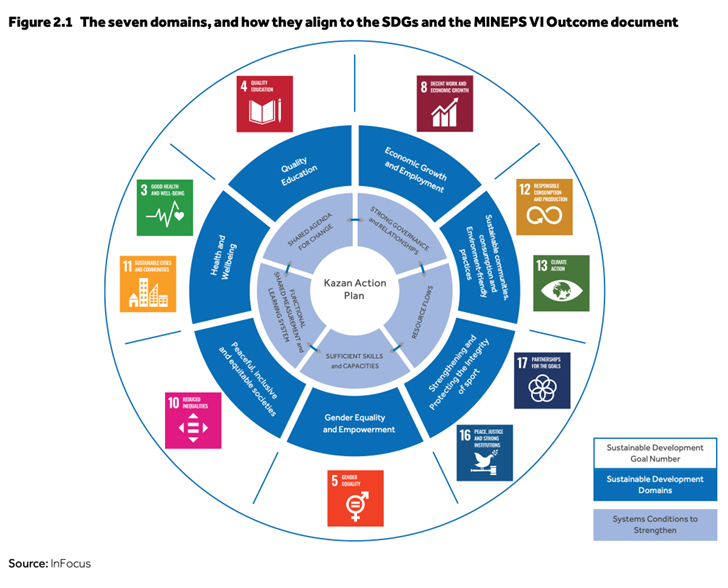
Panellists explored how improved measurement can fundamentally transform sport policy. The development of 60 indicators across seven thematic domains was presented as a clear shift from aspirational approaches to evidence-based decision-making. While acknowledging that approximately 25% of relevant data remains unavailable, speakers agreed that even partial measurement significantly strengthens governments’ ability to justify investment, design reforms, and align sport more closely with public policy objectives.
The discussion also highlighted the political value of data standardisation. Comparable indicators and the Global Sport and SDGs Impact Data Portal were identified as key tools for improving coordination across sectors and levels of government. The publicly accessible dashboard allows users to explore what works, region by region and country by country.
At the same time, panellists cautioned against an overreliance on quantitative data alone. Transformative action, they argued, should not be postponed in pursuit of perfect measurement. Instead, the report offers a shared language that enables sport to engage meaningfully with actors in education, social inclusion, and development, thereby enhancing its legitimacy and supporting sustained investment.
Finally, the panel raised important questions of power and participation. As decision-making in sport remains highly centralised, speakers questioned how communities can move from being passive data subjects to active users of information. In this context, storytelling was emphasised as a crucial complement to indicators, ensuring that lived experiences and local realities remain visible alongside quantitative evidence.
Students’ reflections
From my own perspective, these measurements are precisely what had been missing to fully understand the real contribution of sport to our societies. Coming from a European background, I am not surprised to see that Europe performs below the global average in aligning sport policies with the SDGs, with only around 23 per cent alignment. This gap is partly shaped by the way sport is financed at the EU level, as funding remains largely short term. Programmes such as Erasmus+ illustrate this challenge well, with projects typically limited to three or four years. Without a long-term funding vision, the transformative potential of sport risks being constrained, despite its increasing role in addressing broader societal and developmental objectives.
Another student, Sam Lynch, noted:
“I found the quantitative aspect of the event quite compelling. Working at the intersection between sport and international governance, I am constantly grappling with how to justify the importance of sport relative to other global challenges. The concrete, indicator-led data in the Commonwealth’s report will prove monumental in vindicating new sport for development initiatives.”
The Institute for Diplomacy and International Affairs (IDIA) offers master’s and doctoral programmes designed to meet the evolving demands of today’s world. At IDIA, we work alongside our students to provide them with the essential tools to comprehend these global realities, preparing them for diverse careers in both public and private sectors across the globe. Check out our programmes and apply to study with us here.


Loughborough University London
Blogging everything that’s happening at Loughborough University London