Democracy at the Ballot Box: Moldova’s Post-Electoral Reflection
Written by Dr. Dorina Baltag, Visiting Fellow, Institute for Diplomacy and International Affairs
Post-electoral moments are often treated as administrative closure. Ballots are counted, mandates are distributed, and attention shifts forward. Yet in democracies operating under sustained external pressure and internal reform fatigue, post-electoral reflection is not closure, it is consolidation.
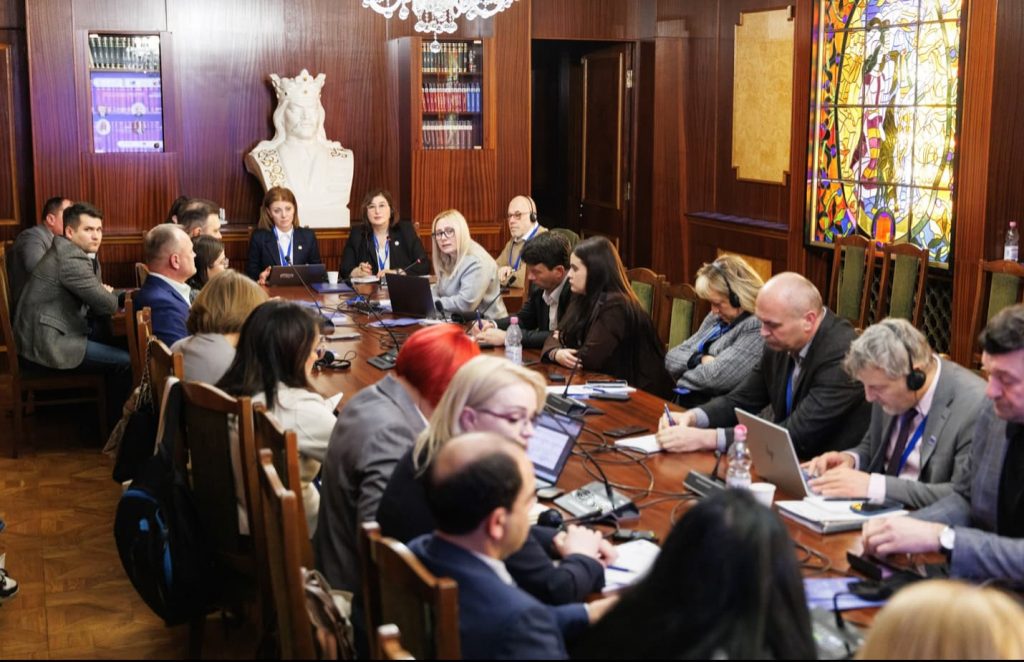
On 19-20 February 2026, the Central Electoral Committee of Moldova convened a two-day post-electoral conference to assess its 28 September 2025 parliamentary elections. Bringing together the electoral administration, public institutions, civil society, international observers, development partners, and diaspora representatives, the event offered something relatively rare in the region: a structured, institutionalised space for collective democratic self-assessment.
Beyond reviewing procedures, the discussions implicitly addressed a broader question: what does democratic resilience look like when legitimacy is contested, trust is fragile, and hybrid interference is persistent?
Resilience Is Produced Through Coordination
A first key conclusion emerging from the data presented is that Moldova’s democratic resilience is not primarily a function of formal institutional capacity. Rather, it is produced through coordination.
The 2025 elections took place in a context of intensified foreign information manipulation and interference (FIMI), illicit political financing risks, and sustained polarisation. Yet the electoral process itself remained operationally robust. This was less the result of institutional insulation and more the outcome of networked cooperation between the Central Electoral Commission, law enforcement bodies, civil society monitors, independent media, and diaspora networks.
For enlargement countries operating in contested geopolitical spaces, this lesson is particularly salient. Democratic security increasingly depends on coordination ecosystems rather than single institutions.
Beyond Numbers: The Diaspora as Political Infrastructure
Diaspora participation was frequently referenced in quantitative terms, i.e., turnout figures, percentage shares, electoral impact. These metrics are undeniably significant. However, numbers alone obscure the structural dimension of diaspora engagement.
The Moldovan diaspora has evolved into more than an electoral constituency. It functions as a transnational civic network, a channel of European norm diffusion, and an informal diplomatic actor shaping narratives about Moldova within EU member states.
Reducing diaspora engagement to voting logistics risks overlooking its strategic democratic function.
Equally, mobilising diaspora participation primarily during electoral cycles leaves a structural gap between episodic political activation and sustained institutional dialogue. In the absence of embedded consultation mechanisms, diaspora engagement remains politically visible but institutionally peripheral.
This creates a paradox: the diaspora is electorally decisive yet governance-light.
Reframing diaspora not merely as voters abroad but as part of Moldova’s democratic infrastructure would shift the discussion from logistics to long-term political integration – a shift that becomes particularly relevant in the context of EU accession and democratic alignment.
Trust as the Missing Strategic Variable
While procedural integrity and institutional coordination featured prominently in the discussions, one critical variable remained underexplored: trust.
Electoral systems can be technically robust and procedurally compliant yet remain vulnerable if public confidence in institutions is fragile. In Moldova’s case, the 2025 elections were not primarily threatened by technical failure. The more persistent risk lies in legitimacy erosion.
Hybrid interference strategies increasingly operate through perception rather than penetration. Their objective is not to disrupt ballot counting, but to cultivate scepticism, amplify grievances, and normalise institutional doubt. In low-trust environments, this form of interference finds fertile ground.
The conference rightly emphasised coordination and resilience. Yet without a parallel strategy for rebuilding social trust, resilience risks remaining defensive rather than transformative.
Why This Matters Beyond Moldova
Moldova’s experience resonates beyond its borders. Enlargement countries operate in an increasingly complex security environment where democratic processes are simultaneously domestic political events and geopolitical arenas.
The post-electoral conference in Chișinău demonstrated a commitment to structured reflection, multi-actor dialogue, and forward-looking agenda-setting. This in itself is a signal of democratic maturity.
For the European Union, Moldova represents both a candidate country and a democratic stress test. Its ability to maintain electoral integrity under hybrid pressure while pursuing accelerated European integration offers insight into the evolving relationship between enlargement and democratic security.
The key lesson is that resilience cannot remain reactive. It must become institutionalised, i.e., embedded in coordination mechanisms, trust-building strategies, and sustained civic engagement. Ultimately, democracy at the ballot box is not only about polling stations and voter lists. It is about predictability, inclusion, and the credibility of the relationship between citizens and the state — both at home and abroad.
Dr Baltag is a Visiting Fellow of the Institute for Diplomacy and International Affairs. She researches EU external relations and diplomacy, with particular focus on democratisation in the Eastern Partnership. Outside of academia she is the cofounder of Noroc Olanda Stichting, a Moldovan diaspora NGO based in the Netherlands. If you would like to get in contact with Dr Baltag, head to her LinkedIn page.


Loughborough University London
Blogging everything that’s happening at Loughborough University London