Erik Solheim on Diplomacy, Development and Global Challenges
By Venthan Kathiramalai (student of MSc Security, Peace-building and Diplomacy)
On Monday 11 May, students, staff, and guests gathered at Loughborough University London for an evening discussion with Mr Erik Solheim on diplomacy, international development, conflict resolution, and global challenges. The event, titled Diplomacy, Development and Global Challenges: In Conversation with Mr Erik Solheim, brought together individuals from a wide range of academic and personal backgrounds for what became a thoughtful discussion on some of the most difficult political questions facing the world today.
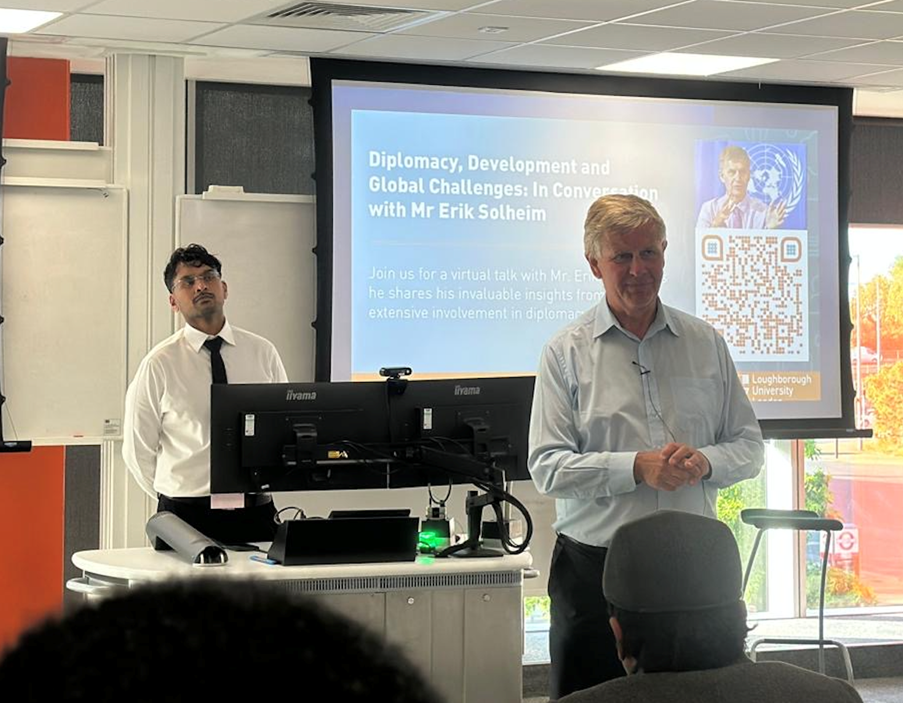
Mr Solheim has had a distinguished career in diplomacy and international development. Over the years, he has held senior positions including Norway’s Minister of International Development and Minister of the Environment, Executive Director of the United Nations Environment Programme (UNEP), and Chair of the OECD Development Assistance Committee. He has also played central roles in several international peace processes, including in Sri Lanka, Nepal, Sudan, and Myanmar.
The evening provided students with the opportunity to hear directly from someone who has spent decades working at the intersection of diplomacy, negotiation, development, environmental governance, and conflict resolution. While many discussions surrounding international politics often remain abstract or theoretical within classrooms, Mr Solheim’s reflections grounded these issues in lived diplomatic experience.
A major focus of the discussion centred around the realities of conflict and peacebuilding. Mr Solheim spoke candidly about the complexity of negotiations and the immense challenges involved in bringing opposing sides together after prolonged periods of violence, distrust, and political division. One point that particularly resonated with attendees was his view that compromise should not automatically be seen as weakness. Instead, he described compromise as one of the most difficult yet necessary aspects of diplomacy and conflict resolution.
Drawing from his experiences in Sri Lanka, Mr Solheim reflected on the peace process during the early 2000s and the pressures faced by all sides involved. He explained that negotiations are rarely as simple as “two sides sitting at a table.” Behind every formal peace process are multiple layers of political tension, internal division, competing interests, public pressure, and historical trauma.
He discussed how, on the Sri Lankan state side, political parties often deeply distrusted one another and frequently focused on identifying weaknesses or failures within the negotiation process itself. Simultaneously, on the Tamil side, there were tensions surrounding representation, legitimacy, and inclusion, with questions emerging from other militant and political groups regarding why they were not directly included within the talks.
Mr Solheim also reflected on the nature of the Liberation Tigers of Tamil Eelam (LTTE) during this period. He explained that while the LTTE were an extremely strong military force, they were not politicians in the traditional sense, which created major challenges within negotiations and political settlement-building. This distinction between military capability and political governance became an important point of discussion throughout the evening.
One particularly thought-provoking aspect of the event was the discussion around the motivations behind peace negotiations themselves. Mr Solheim reflected on the misconception that armed groups only pursue negotiations from positions of weakness. Referring to Sri Lanka specifically, he noted that the LTTE entered peace talks during a period in which they were arguably at the height of their military strength. This included the aftermath of major developments such as the capture of Elephant Pass and the attack on Bandaranaike International Airport, both of which significantly impacted the Sri Lankan state.
His reflections encouraged students to think more critically about how peace processes emerge and how political actors perceive negotiation, compromise, leverage, and legitimacy during periods of conflict.
The conversation also expanded beyond Sri Lanka and into broader global trends surrounding war, diplomacy, and international instability. Mr Solheim reflected on conflicts across different regions of the world, including Sudan, Ukraine, Gaza, Myanmar, and Nepal, discussing recurring patterns that emerge within prolonged conflicts.
One particularly striking part of the discussion was Mr Solheim’s reflections on lessons drawn from peace processes and wars across different parts of the world, including Sri Lanka, Nepal, Myanmar, Sudan, Iran, Ukraine, and Gaza.
He noted that one of the most important lessons from modern conflicts is that wars almost always become far more prolonged and destructive than those initiating them expect. Referring to examples ranging from Russia’s invasion of Ukraine to historical conflicts such as Germany’s invasion of the Soviet Union during the Second World War, he reflected on how political leaders repeatedly underestimate the complexity, resistance, and long-term human consequences of war.
This broader reflection led into discussion around the importance of diplomacy, communication, and sustained peacebuilding efforts internationally. Rather than seeing conflict as something resolved quickly through force alone, the evening emphasised the importance of developing stronger global conversations and movements centred around peace, negotiation, and long-term political understanding.
Students also engaged with Mr Solheim on questions surrounding international development and environmental governance. Given his experience leading UNEP and working across sustainability initiatives globally, he reflected on how climate change, development inequality, conflict, migration, and governance are increasingly interconnected.
Rather than treating environmental issues as separate from diplomacy or development, Mr Solheim emphasised that modern policymakers and diplomats must increasingly understand these issues as deeply linked. Environmental instability can fuel political instability, displacement, and economic hardship, while poor governance and conflict can simultaneously undermine environmental protections and long-term sustainability.
A recurring theme throughout the evening was communication, particularly the importance of communicating complex political and diplomatic ideas to wider audiences. Students studying diplomacy, development, and sustainability were particularly interested in hearing how international actors communicate with governments, civil society, businesses, media institutions, and the public.
Mr Solheim reflected on how effective diplomacy often requires not only negotiation behind closed doors, but also the ability to communicate difficult realities across deeply divided societies. This aspect of the discussion was especially valuable for students hoping to enter careers in international relations, development, policymaking, or global governance.
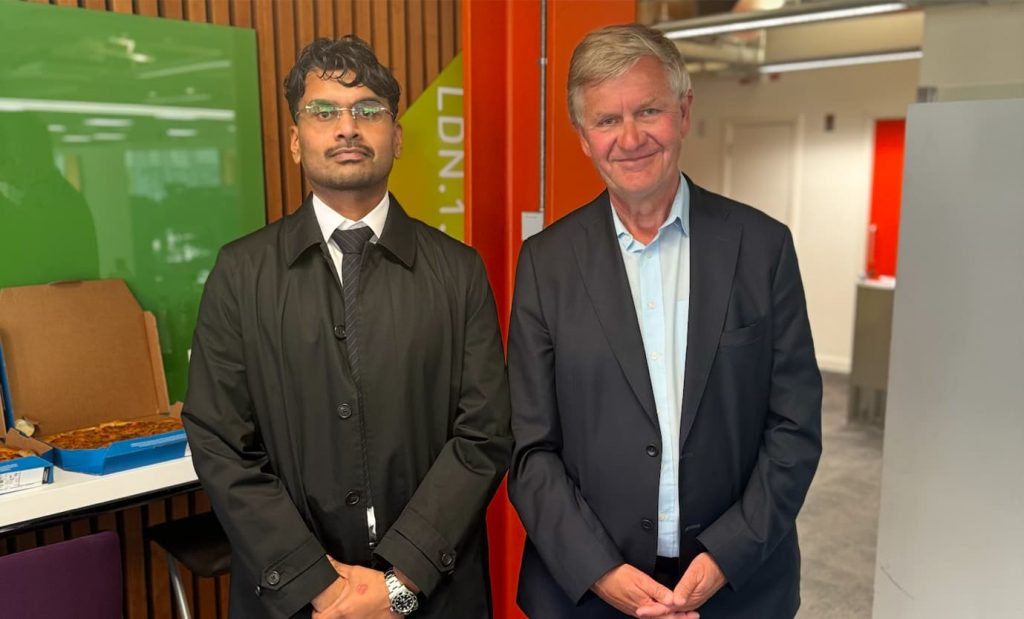
Outside of the formal lecture itself, many students also valued the opportunity to speak with Mr Solheim more informally during the networking session afterwards. Conversations continued around reconciliation, identity, diaspora communities, and the responsibilities of younger generations engaging with questions of conflict and political history.
Another important reflection emerging from the evening concerned the importance of historical understanding across communities affected by conflict. Discussions throughout the event highlighted how easily societies can become trapped within singular narratives, often without fully engaging with the experiences and fears of others involved.
This led to broader reflections on the need for stronger cultures of dialogue and peacebuilding within societies themselves. While governments and international actors remain important, lasting peace also depends on ordinary people creating space for understanding, education, and serious conversation rather than constant division.
A point that resonated strongly with many students was the reminder that political conflicts are ultimately lived and suffered by ordinary people. Decisions made through anger, fear, ideology, or reaction carry real human consequences for families, communities, and future generations.
In many ways, the evening demonstrated the importance of universities as spaces for serious dialogue. Discussions around conflict, peacebuilding, reconciliation, and diplomacy are often emotionally charged and politically sensitive. However, events such as this show the value of creating environments where difficult conversations can still take place thoughtfully, respectfully, and critically.
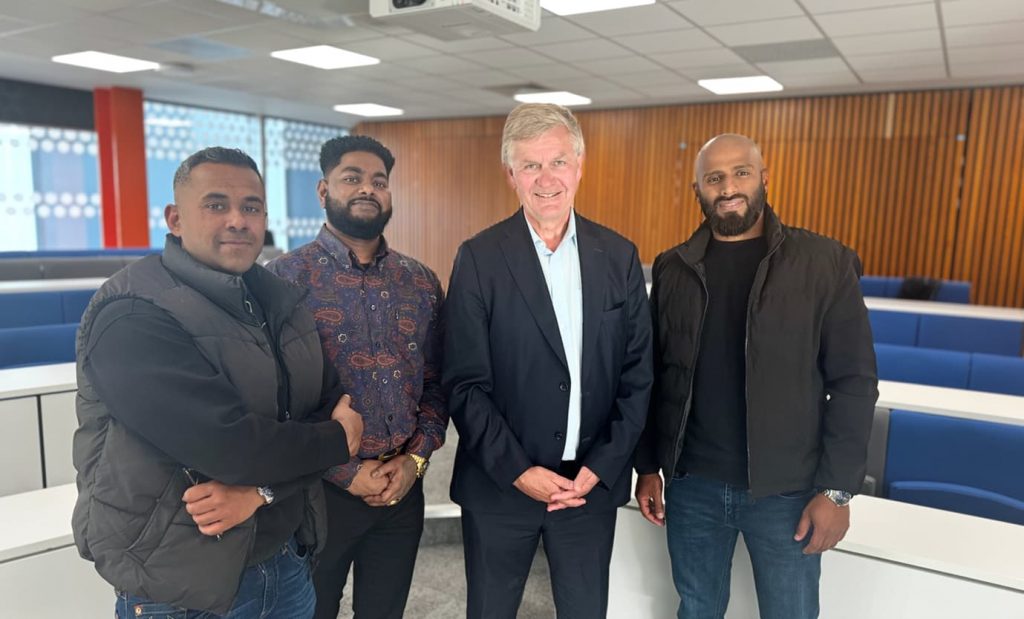
The event also highlighted the appetite students have for engaging directly with practitioners and individuals who have worked at senior levels within international affairs. For many students, hearing first-hand reflections from someone deeply involved in peace processes and international governance provided perspectives that extend beyond textbooks and classroom theory.
Importantly, the discussion was not framed around simplistic conclusions or easy answers. Instead, students were encouraged to grapple with complexity, to recognise that conflict resolution is rarely straightforward, that diplomacy often involves compromise between imperfect options, and that historical events are shaped by multiple actors, pressures, fears, and competing visions.
The atmosphere throughout the evening reflected this seriousness. Students remained engaged throughout the discussion and continued conversations long after the formal event had concluded. Many attendees expressed appreciation for the honesty, depth, and nuance that Mr Solheim brought to the discussion.
Loughborough University London would like to thank Mr Erik Solheim once again for taking the time to visit, speak with students, and share his experiences and reflections so openly.


Loughborough University London
Blogging everything that’s happening at Loughborough University London