From Fairy Tales to Franchises: Disney’s Public Domain Playbook
I am sure you figured out by now that I am a huge Disney fan. I think the term used to describe someone like me is Disney adult. Even though I only fall into the one category. While I don’t cosplay nor do I visit Disneyland a lot. Only been once in my life, I enjoy watching Disney movies and at times buying Disney merchandise, either for friends or family.
So how did Disney become, well, Disney. In July 1923, 21-year-old Walter Elias Disney moved to Los Angeles to join his brother Roy and pursue a career in animation. A few months later, the brothers founded the Disney Brothers Cartoon Studio, operating from a small office in Hollywood. Success did not come overnight. It was 1928’s Steamboat Willie, one of the first cartoons to feature synchronised sound, that captured audiences’ attention and launched Disney’s rise to fame.
It will take another 10 years before the next big leap for the Disney brothers. Snow White and the Seven Dwarfs was among the world’s first feature-length colour animated films and, upon its 1938 release, became the highest-grossing film ever made. This movie is based on the fairy tale story the Brothers Grimm collected, Snow White.
Snow White and the Seven Dwarfs is not the only fairy tale and public domain story Disney has re-imagined. Below are some of the most treasured Disney stories based on public domain material. But first, let’s have a quick reminder of what the public domain is.
When Old Tales Become New Tales
The public domain refers to material to which copyright has expired or has been relinquished. Now in the UK, public domain can also be used for the Internet and there can be confusion from that. While there is material which can be found in the public domain, that does not mean it is free to use or re-use. Even though public domain material can be found on the Internet. Confused yet?! This is why certain terms should not be used to describe other things.
If you follow this blog, you will know by now that copyright expires, but to make it harder it tends to expire at different times in different countries. As such:
- a term which lasts for 70 years after the creator’s death (relevant in UK, Canada, most of the EU, and South America);
- a term which lasts for 50 years after the creator’s death (relevant to most of Africa and Asia);
- a term which lasts for 95 years after the publication of a film or book, including any artworks featured within (relevant solely to the United States).
Now this is a simplification of how copyright works enter the public domain. There are a number of exceptions and other subtleties which make things way harder than they have to be.
Fairy Tales reimagined: The Disneyfication of Old Classics
Let’s have a look at some of the public domain stories, which Disney has reimagined.
Snow White and the Seven Dwarfs (1937)
Released in 1937, Snow White and the Seven Dwarfs was Disney’s first feature-length animated film and a landmark in cinema history. Adapted from the Brothers Grimm fairy tale, it reimagined a well-known public domain story for a new audience, adding memorable characters, music, humour, and a happier tone. The film was a huge commercial success, established Disney as a major force in animation, and became the version of the story most familiar to audiences today.
The Little Mermaid (1989)
Disney’s The Little Mermaid was inspired by Hans Christian Andersen’s 1837 fairy tale, which had already entered the public domain. While Andersen’s original story ended tragically, Disney reimagined it with a more optimistic ending, memorable songs, and a stronger focus on adventure and romance. The film became a major success and helped launch the Disney Renaissance, demonstrating how classic public domain stories can be transformed for new generations of audiences. Spoiler alert: The Andersen original story does not have a happy ending. The Little Mermaid becomes foam and then Triton transforms her into an air fairy.
Beauty and the Beast (1992)
Beauty and the Beast is one of my favourite Disney movies. I mean who does not want that fantastic library? Right? Right? Anyway, the original story is French and has been retold a number of times. Unlike the Disney version, the merchant (Beauty’s father) steals a rose from the Beast. In return for not being punished the Beast offers the merchant a deal, one of his daughters for the rose. Beauty agrees to go to the Beast’s castle. Although the original version is a bit more convoluted, the gist is pretty much the same as Disney’s version.
Tangled (2011)
Tangled is another one of my favourite ones. The original story is a bit bleak and dark, as are most of the Grimm’s Fairytales. I have to admit, I loved the Grimm’s Fairytales as a child, and no I saw nothing wrong with cutting toes or heels (Cinderella) or being blinded by thorns when falling from a tower (Rapunzel). I had to giggle when my brother bought the fairytales and wanted to read them to his two children, and realised how violent they actually are. Because like me he grew up with them and loved them. I mean I grew up with Slavic and Romanian stories. Trust me, they can be worse.
Tangled however, is mostly a very fun story, with a strong female lead. One thing that Disney does well are female leads.
Frozen (2013)
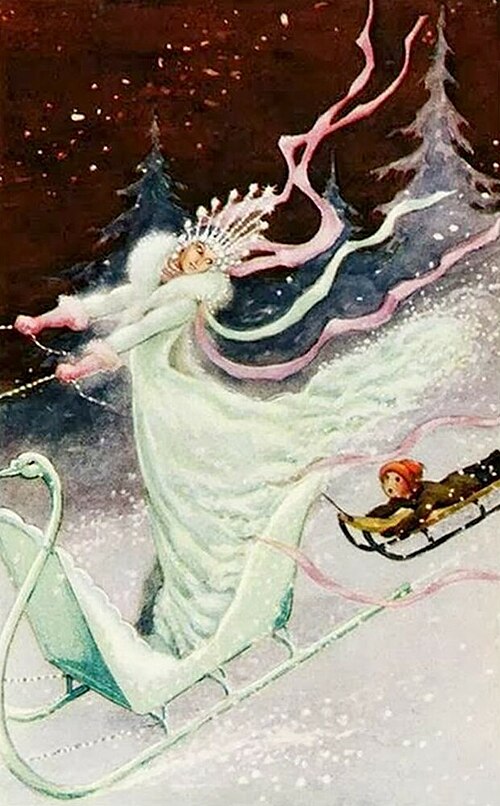
Frozen follows the story of two sisters, Anna and Elsa, one with magic powers, one without. We have a speaking snowman and an ice palace. Imagery is beautiful, as Disney is want to do, and the soundtrack is also amazing. The story however is based on the story by Hans Christian Andersen, The Snow Queen. Rather than dealing with sisters the story is around two friends, a boy and a girl, and the boy becomes mean after being pierced by an evil mirror shard and goes and lives at The Snow Queen’s palace. The girl goes on a rescue mission. It is a beautiful story, and I suggest you read it for yourself. It is vastly different to Frozen.
Disney also has an array of stories based on myths and folklore, like Hercules, Moana or Atlantis: The Lost Empire.
Reinterpretation, not Replication
It is important to underline the fact that Disney doesn’t reproduce these stories exactly. They make them family friendly and give them a happy ending. They also leave out the brutality. Which is why my brother had a shock when he read the Grimm’s Fairy Tales to my nephews. Fairytales tend to have a moral, but they also tend to be created to teach children something. While Disney still teaches those values, it does it in such a way that the ending is happy, without losing the core story.
These reimagined stories acquire copyright protection of their own. They also can be protected by other IP like trademarks or design rights. It is not only the new stories that are generated from the myths and fairy tales that are being reimagined, but also merchandise.
It is these creative choices, including altered plots, new characters, distinctive visual designs, songs, dialogue, and settings, that transform a public domain story into a new copyrighted work. While the underlying fairy tale remains available for anyone to use, Disney’s specific expression of that story is protected by intellectual property law. This means others can adapt the same fairy tale, but they cannot copy Disney’s particular version of it. Until of course, that one enters the public domain.
A Twist in the Tale: Disney’s Copyright Strategy
It is clear that Disney created an empire and new material from public domain stories. If you are a copyright afficionado, you would also know that Disney has protected its own creations, strongly. You might also have heard of the Mickey Mouse Protection Act or by its real name the Sonny Bono Copyright Term Extension Act. The law extended copyright protection by 20 years, partly delaying the entry of early Disney works, including Steamboat Willie (1928), into the public domain. Critics argued that the extension primarily benefited large copyright holders such as Disney, while supporters claimed it helped protect valuable creative works and align U.S. copyright terms with those in Europe.
However the case may be, Steamboat Willie is now in the public domain. For more information on the different IP Disney uses to protect its creations, why not have a read of The IP Strikes Back: Lucasfilm, Disney, and the Power of Copyright in a Galaxy, Far, Far Away.
Why Public Domain Matters
For as long as human beings have existed, they have drawn inspiration from others. That other can be nature or other human beings. The Public Domain is a treasure trove of the human experience and imagination. And sometimes that can spark other creations, which in turn become much loved.
For example, Bridget Jones Diary is inspired by Pride and Prejudice. Wicked is inspired by The Wizard of Oz. You can have a look at more examples, on the Books in the Public Domain – and the Stories They Inspired website.
They also make adaptations easier, this year we are getting a new Sense & Sensibility (I must admit, not a fan after seeing the trailer, what is with that hair??!!) and of course the new Pride and Prejudice streaming on Netflix on the 3rd of December.
Reimagining public domain stories does not mitigate or erase the originals but promotes them for future enjoyment by others, which is why the public domain needs to be cherished and celebrated.
Here are some useful links:
Happy reading and if inspiration strikes you, why not write your own story!
All images used are licensed from Adobe Stock. Images not from Adobe Stock are cited accordingly. Images showing Disney logos are used for editorial purpose only.
The information contained in this blog post should be taken as recommended advice or guidance but should not be taken as legal advice. If in any doubt, please seek proper legal advice.


Open Research, Copyright and Archives
Sharing Research, Respecting Rights, Preserving Memory