Solar Panels – are they worth it?
This blog post has been written by Nik Hunt, Loughborough University’s Environmental Manager.
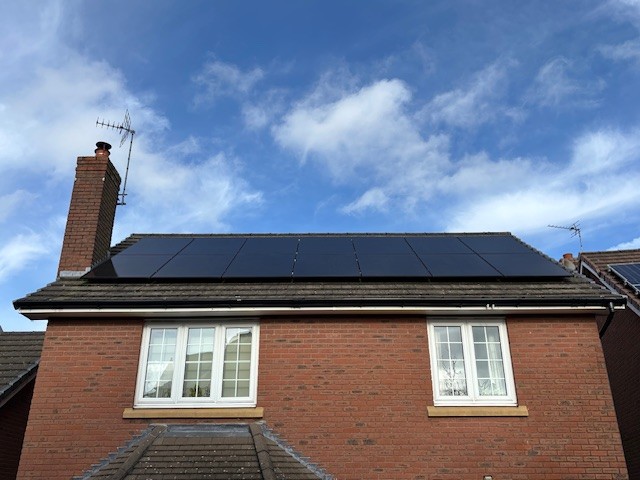
As Loughborough University’s Environmental Manager for 14 years it may surprise many to learn that I only installed solar panels on my home 12 months ago. Through this blog I explain the concerns I had, which many may have shared, which delayed this choice, what finally convinced me, and how I feel 12 months on, sharing some of the performance figures from my installation.
Why didn’t I install solar panels earlier?
My career started at Loughborough University over 28 years ago and I only got interested in Environmental Management in my late 30’s so in fairness I was still learning a lot in my early 40’s. Of course, costs were a major consideration as was the possibility I may move house, yet here I still am.
Costs.
So, let’s talk costs as the main consideration. When it comes to big expenditures, a house and car are probably the biggest, a wedding may be in there too (so I am led to believe). Extensions or additions to a house probably come next and solar panels are no different although the costs are not, perhaps, as bad as they use to be.
According to web sources the cost of a solar panel installation has decreased by anywhere from 73%1 to 90%2 over the last 10 years.
UK Government data3 for UK installations doesn’t show such a great reduction but an 18% inflation adjusted reduction for the average price of a 4-10kW installation nonetheless.
My first experience of the likely costs was a discussion with a previous colleague who had solar panels installed over 10 years ago at a cost of around £20K. My first enquiry for a quote though wasn’t until 2022 where the system, including a battery, would have cost around £15K, which still seemed a lot. Then of course the war in Ukraine came along and the cost of both Gas and Electricity dramatically increased, and I started to think about it again. A random encounter with a Renewable Energy Consultant, through my work supporting the Civic Universities Partnership, then occurred in 2024. He was doing a dissertation on why people were not taking advantage of solar panel installation schemes, and this then led to a conversation as to why I hadn’t taken the plunge and an offer from him to design and provide a quote for a system through a local supplier.
The process of designing a solar system isn’t that difficult, with the right tools, in fact at least one of the companies I sought a comparative quote from did it all remotely using google earth with a few questions by phone/email to determine the potential roof space, orientation and pitch. I would however recommend working with a company who come and visit before your sign anything and will explain more on that later.
Different system options.
One of the big cost differences with a solar installation is whether to have a battery or not. On my first quote the battery was more than 50% of the system installation cost yet when I took the plunge my battery (2 x 4kWh) cost around 25% of the total installation. Of course the benefits of a battery will depend on how you plan to use your system, how much you are at home, your usage, time you are at home etc.
The advantages of a battery
I think we all know that the demand for electricity varies throughout the day and many of us will know that as a result many electricity retailers offer packages that vary the price to reflect these demand variations. A battery allows a household to manage and take advantage of these price variations, filling the battery with solar generation (free) or from the grid during low cost electricity periods (cheaper overnight) and then taking advantage of this by using the stored energy and/or solar generation during the day when energy costs are higher. Exporting solar generation and stored energy during higher value periods also has the potential, of course, to maximise your income potential.
Key factors in the solar generation potential of your roof space.
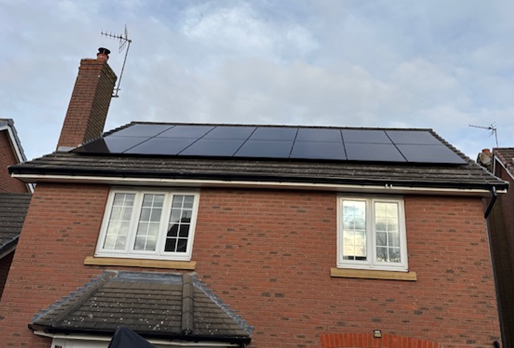
OK so everyone will immediately think south facing is the best, and yes on the whole this is correct, but there are other factors that can effect solar generation. I’m lucky in that I have a south facing roof but I lose out on late afternoon sun because of my chimney. A house with a west facing roof will benefit from the afternoon and evening sun at a time when demand and costs can be at their highest. Solar4good offers a good explanation of the differences as a result of orientation and pitch. Not all installations have to be on one side of your roof, I’ve seen installations that have multiple panels orientated in different directions which enables generation throughout the day. Obstacles which cast a shadow can be a problem depending on how your system is configured, as mentioned I have a chimney which casts a shadow over 4 of my panels and so it was recommended I fit Tigo Optimisers (other brands are available) which prevents my system from not operating at optimal levels when some panels are shaded.
Of course one of the big factors in the solar generation potential of your roof space is the number of panels which can be accommodated. The panels themselves are actually not that expensive, mine were only about 30% of the overall cost (around £200 each), meaning that a big part of the cost is the inverter, battery, labour and scaffolding costs. Logic therefore would suggest, IMHO, that you install as many as you can whilst the scaffolding and labour is on site. Here lies another reason for insisting on a site visit. The panels themselves are not mounted directly on the roof, they are mounted on a rack. The rack is mounted by removing tiles and attaching the rack to the roof trusses, so the positioning of the roof trusses in relation to the edge of the roof can impact on the positioning and hence number of solar panels.
My choices.
I decided, despite being single with no children, to go for as many panels as would fit on my roof and a fairly large battery. I did this for two reasons. Firstly the number crunching I did suggested the payback period would not be effected by the additional (£1K) outlay but that the system income over its lifespan would be increased be £12K. Secondly my house is large enough for the average family and therefore maximising the solar potential seemed logical for when I do eventually sell.
My installation therefore included: 14 x 435W panels with a 6.09 kWp theoretical peak output (under optimal conditions), 4 Tigo panel optimisers, 6kW inverter and a 8.29kWh capacity battery pack. This system cost approximately £9K
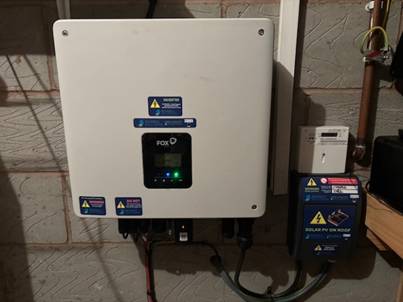
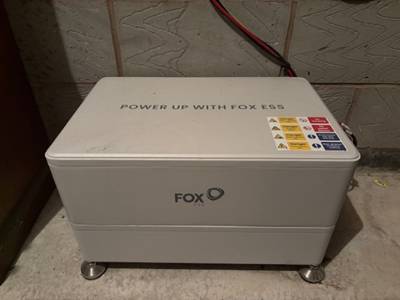
Now by this point I suspect you’re all dying to know how it has performed… well here are some figures for you:
- The system was forecast to produce 5523 kWh per annum, in the first year they have actually produced 6331 kWh
- The saving in year one was forecast to be £1146 but this was based on:
- Export rate of 15p generating £414.25 of income
- Unit costs of 26.5p
- Exporting 50%
My figures are telling me my income is £577.50 and my year 1 savings are £1385
- What does this mean for the payback?
- The designers prediction was between 6-7 years
- My prediction at current rates is 5 years and 7 months or allowing for the lost interest on the savings 6 years and 1 month
- However do consider:
- Import and export rates effect these figures,
- The weather is unpredictable, some days the panels produce very little (less than 1 kWh) but on peak days over 35kWh (39.2kWh 12th July 2025). Even on a sunny winter day they can produce over 15kWh (16.8kWh on boxing day this Christmas)
- How much you use can impact payback – a family purchasing more grid electricity at standard rates will benefit more from the solar they generate from using it than exporting it.
- What the installers don’t include in their figures is any added value to your property. In a report from 2024 Homebuilding & Renovating4 quoted sources that indicate that the added value can be from 0.5-2% (source was Octopus Energy) or as much as 4% (source was a Director of property company). The basis of this is that the solar panels will improve the EPC rating of your property. Now whether this would add to your selling price or just make the property more sellable in comparison to a like for like property without solar panels is unknown but at just 2.5% my installation costs would be covered so that’s something to be considered in the payback surely.
- My figures would have been slightly better had I chosen my current energy supplier and purchaser but I wrongly assumed I would benefit more with the supplier I chose but their decision to increase import costs whilst reducing export costs made me re-evaluate and change suppliers which lost me a couple of weeks of income and lowered my first 4 months so I expect this year to be even better.
Additional Reasons for ensuring a site visit
To survey access, scaffolding positioning, where the mounting rack can be attached to, the number of panels which can be achieved, potential shadows, battery and inverter positioning, cable runs, meter location, type of equipment in place and which will best fit the spaces.
Why should we be installing more home solar?
Solar is readily abundant – the earth received enough sunshine (343 watts per square meter) on average to meet all our needs, we just need to harvest it, store it and distribute it. We could be doing more. The Netherlands is 1/6th the size5 of the UK yet harvests 50%6 more solar power. Germany might be 45%5 bigger than the UK but they harvest a staggering 5 times6 more solar power.
1 – Solar panel costs have dropped 73% in the last 10 years, gov’t data shows | Homebuilding
2 – The Declining Cost of Solar Panels
3 – Solar photovoltaic (PV) cost data – GOV.UK
4 – Do solar panels add value to your home? We ask the experts | Homebuilding


Sustainably Speaking
Loughborough University Sustainability Blog