Seeing Early Maths Differently: A 360° View of Preschool Learning
Written by Dr. Natalie Flint, Postdoctoral Research Associate at the Centre for Early Mathematics Learning at Loughborough University. Her research explores how mathematics learning interactions unfold in early childhood settings. This blogpost draws together ideas discussed at a Festival of Creative and Digital Methods workshop delivered by members of Loughborough University’s award-winning Discourse and Rhetoric Group (DARG) and recordings of children in pre-school settings collected in Challenge 3 of the Centre for Early Mathematics Learning (CEML).
Understanding what actually happens when young children explore mathematical ideas is central to early childhood mathematics education research. Yet the fine-grained details of how 3–4-year-olds use talk, gesture, materials, and space during learning activities can be difficult to capture with traditional video. Early years interactions are dynamic, with hands moving quickly, objects shifting constantly, and children’s attention changing moment by moment.
At this year’s Festival of Creative and Digital Methods (Loughborough University), DARG colleagues and I introduced delegates to an emerging methodological approach: interactional analysis of recordings captured by 360° cameras, supported by DOTE, a software tool designed for the fine-grained study of social interaction. While Conversation Analysis (CA) has long helped researchers understand real world communication, combining CA with 360° footage opens powerful new possibilities for studying early childhood learning.
A New Lens on Early Mathematics Interactions
In ongoing research within Centre for Early Mathematics Learning (CEML), compact 360° cameras are placed directly on tables in the preschool. This setup allows us to record from the centre of children’s engagement, capturing:
- every child seated around the table
- their hands, gestures, gaze, and use of materials
- the spatial arrangement and movement of mathematical objects
- peer collaboration, turn taking, and shared problem solving
Unlike traditional cameras, which often miss crucial details, 360° footage allows researchers to follow how children’s attention shifts, how they manipulate objects, and how mathematical reasoning emerges through embodied action.
How We Capture the Interactions: Cameras and Recording Setup
To document these rich learning interactions, we use a GoPro Max camera positioned at the centre of the activity table. The GoPro Max records in full 360° format and is compact enough to sit unobtrusively among the materials children are using. This placement ensures that every child seated around the table is visible, along with their hands, gaze, gestures, and moment to moment engagement with the mathematical resources.
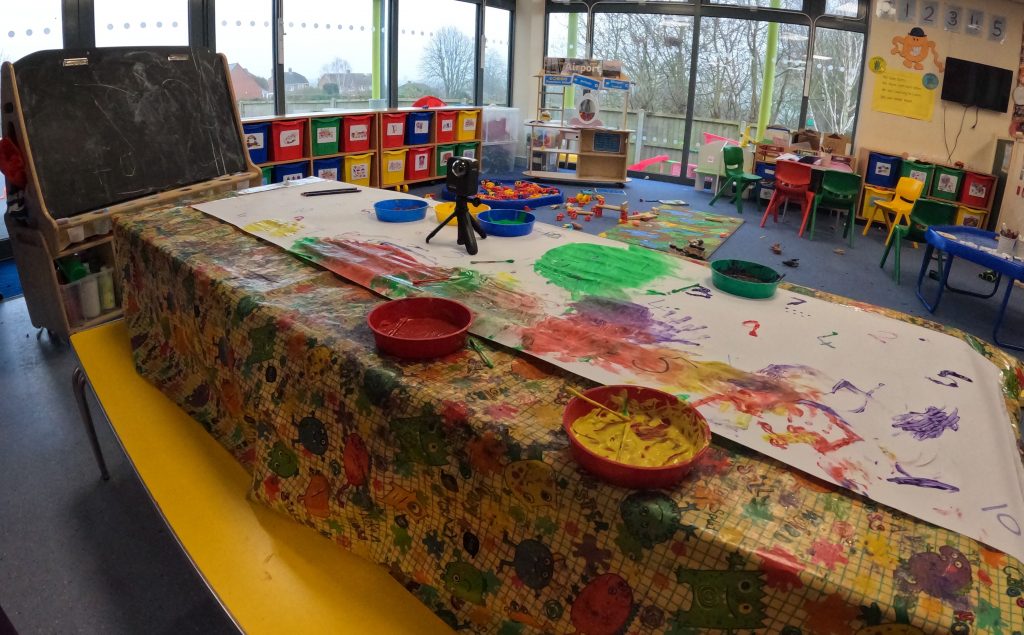
The wide field of view and stabilisation provided by the GoPro Max make it ideal for early childhood environments where interactions are rapid and materials are constantly being manipulated. Because it captures movements from all directions, the camera allows us to see delicate adjustments to objects, fleeting gestures, and subtle spatial reorganisations that often signal emerging mathematical thinking.
What 360° Video Helps Us See in Early Maths
360° video offers a uniquely rich view of early mathematical thinking. It enables researchers to:
- trace spatial arrangements as children line up counters, cluster shapes, or compare lengths
- observe gesture and fine motor action involved in counting, grouping, measuring, or patterning
- identify coordination within small groups, including negotiating turns and sharing materials
- capture micro moments of reasoning, for example when a child lightly adjusts objects to check equivalence
- support educators’ reflections by revealing aspects of practice not visible in real time
These insights allow researchers to examine early learning as it unfolds, revealing the multimodal foundations of young children’s mathematical thinking.
More about DARG
DARG, Loughborough University’s world leading Discourse and Rhetoric Group, has a long-standing tradition of excellence in Conversation Analysis and Discursive Psychology, supported by weekly data sessions, workshops, and collaborative events that bring together researchers who study language and social interaction across many real-world settings. This vibrant interdisciplinary community provides an ideal environment for advancing methodological innovation, including 360° video analysis for educational research.
If you are interested in analysing 360° footage (or other types of video footage), exploring how multimodal analysis could enhance your educational research, or connecting with collaborators for future projects, we would love to hear from you. Together, we can open new ways of understanding learning, teaching, and the everyday interactions that shape them.
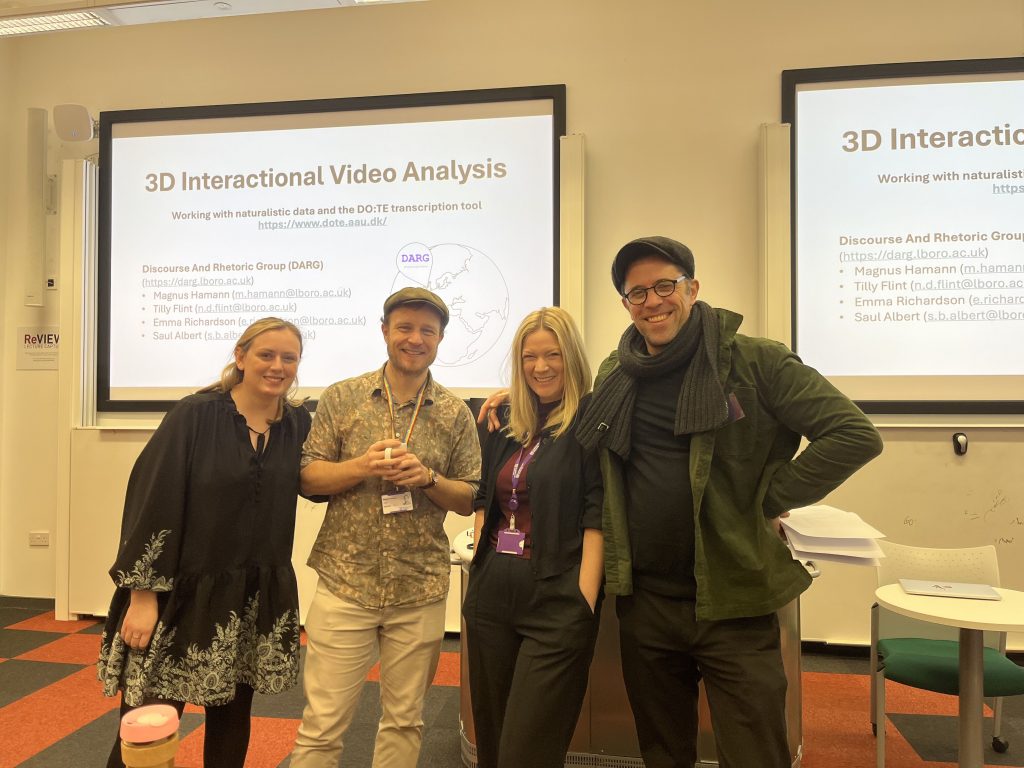
Learn more at: https://darg.lboro.ac.uk
I want to thank the nurseries/schools, practitioners, and children for participating in this research. We are grateful to the educational practitioners with whom we co-designed the game, and those who helped with the piloting phase. This work was partially supported by UKRI Economic and Social Research Council [grant number ES/W002914/1]). I would like to thank DARG colleagues, Dr Saul Albert, Dr Magnus Hamann, Dr Laura Jenkins, and Dr Emma Richardson, for running the session that informed this blog and for offering thoughtful feedback that strengthened the development of the blog.

Written By
Centre for Mathematical Cognition
Posted On
Centre for Mathematical Cognition
We write mostly about mathematics education, numerical cognition and general academic life. Our centre’s research is wide-ranging, so there is something for everyone: teachers, researchers and general interest. This blog is managed by Joanne Eaves and Chris Shore, researchers at the CMC, who edits and typesets all posts. Please email j.eaves@lboro.ac.uk if you have any feedback or if you would like information about being a guest contributor. We hope you enjoy our blog!


Centre for Mathematical Cognition
We write mostly about mathematics education, numerical cognition and general academic life. Our centre’s research is wide-ranging, so there is something for everyone: teachers, researchers and general interest. This blog is managed by Joanne Eaves and Chris Shore, researchers at the CMC, who edits and typesets all posts. Please email j.eaves@lboro.ac.uk if you have any feedback or if you would like information about being a guest contributor. We hope you enjoy our blog!