Order processing deficits in children with dyscalculia: What do we actually know?
This blogpost was written by Dr Declan Devlin (Norwegian University of Science and Technology) and Dr Natalia Dubinkina (Higher School of Economics, Russia). Their research focuses on the development of early numerical skills and the cognitive mechanisms underpinning basic numerical processing.
In this post, Declan and Natalia discuss their recent research exploring order processing skills in children with developmental dyscalculia. This includes an empirical study co-authored with Eveline De Praetere and Prof. Bert Reynvoet from KU Leuven (Belgium) and Dr Francesco Sella from the University of Padova (Italy). The original article describing this study can be found here. This post also draws on a recent review co-authored with Prof. Pirjo Aunio from the University of Helsinki (Finland), which can be found here. Together, this post explores what order processing deficits in children with dyscalculia actually represent, highlighting that these difficulties may be more complex than they first appear.
Introduction
The ability to process ordinal information is considered highly relevant to early numerical development. For example, the faster and more accurately a child can identify that 1-2-3 is in order but 2-1-3 is not, the higher they are likely to score on an arithmetic task1,2. The strength of this association has motivated many mathematical cognition researchers to investigate the cognitive mechanisms underlying order processing and its relationship with arithmetic. We discussed some of these mechanisms in our previous blog post last year.
Beyond this broader relevance to numerical development, accumulating evidence suggests that order processing difficulties may be particularly prominent in developmental dyscalculia. In particular, children with dyscalculia consistently show poorer performance on order processing tasks than typically developing children3,4, with these deficits even being observed in children as old as 13 years5. Such order processing difficulties may be one of the most relevant features of dyscalculia. For instance, in one study, performance on order processing tasks classified children with and without dyscalculia with up to 82.5% accuracy, outperforming more commonly investigated predictors including magnitude comparison and executive functioning tasks6.
Despite this apparent importance, however, order processing deficits in dyscalculia have received relatively limited research attention. In fact, the 2015 International Handbook of Dyscalculia and Mathematical Learning Difficulties used the term “ordinal” only seven times across its 460 pages7,8. To improve our understanding of this topic, therefore, we decided to review the literature on order processing deficits in developmental dyscalculia to establish what is known, highlight areas of consensus and disagreement, and identify where evidence is lacking.
Overview of the literature
We searched the literature for studies that included both (i) participants with some form of mathematical learning difficulties and (ii) at least one measure of order processing skills. This search identified 15 relevant studies published between 2006 and 2026. Most of these focused on children aged approximately 8–12 years, although a small number investigated older children or adults. The majority of studies specifically investigated developmental dyscalculia, while a few used broader definitions of mathematical learning difficulties.
We also considered what tasks researchers used to measure order processing. A recent review of the broader literature highlighted that 18 different tasks have been used to assess order processing9. However, by far the most commonly used is the symbolic numerical order verification task, in which participants are shown sequences of digits (e.g., 1-2-3) and asked to judge whether they are in order. This preference was also present in our review as 13 of the 15 studies included an order verification task, and seven of these studies used it as their sole measure of order processing.
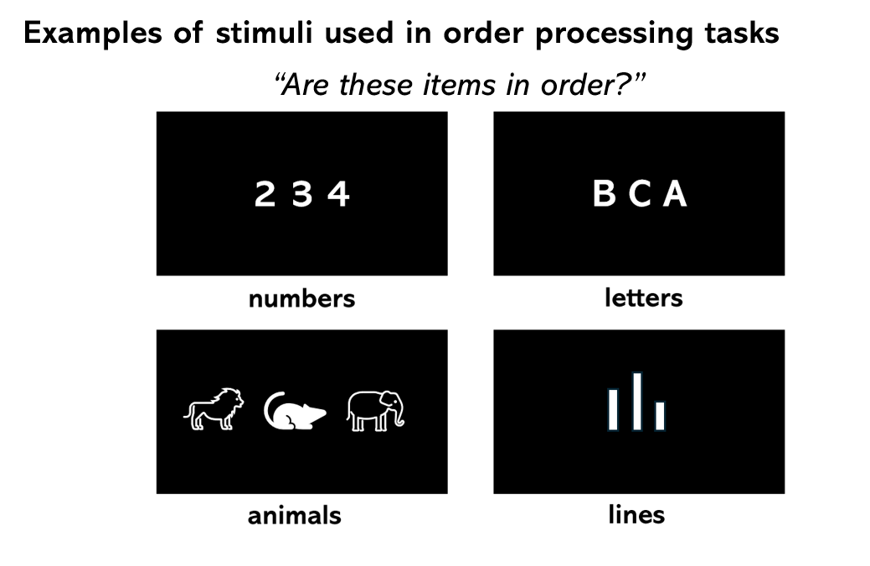
Other tasks, however, have also been explored in this literature, including judging whether letters or familiar calendar events were presented in the correct order, or whether sequences of objects were arranged according to their size (see figure below for examples). This variety of tasks enabled us to explore an important question: do children with dyscalculia show a general deficit in order processing, whereby they struggle across different forms of ordering, or are their difficulties specific to particular tasks or even particular aspects of these tasks?
Are these deficits general across tasks?
It has been well established that children with dyscalculia struggle with symbolic number order verification10, but what about other forms of order processing, including non-symbolic and non-numerical ordering?
Evidence suggests that these difficulties do extend beyond the traditional numerical order verification task. For example, Morsanyi and colleagues6 found that children with dyscalculia were less accurate than typically developing children at identifying incorrectly ordered sequences of familiar annual events (e.g., Easter—Christmas—Halloween).
More recently, Träff and colleagues4 found that children with mathematical learning difficulties performed worse than a control group across both numerical and non-numerical ordering tasks. For example, the non-numerical tasks required children to judge whether letters were in alphabetical or reverse alphabetical order, or whether sequences of lines increased or decreased in length (see figure above for examples).
The authors of these studies interpreted their findings as evidence that dyscalculia may be characterised by a general order processing deficit that extends beyond the traditional symbolic numerical order verification task.
Are these deficits specific to certain sequences?
Although order processing difficulties have been observed across a range of tasks, it remains plausible that these deficits are actually specific to certain aspects of order processing. In particular, research using the traditional verification task suggests that children with dyscalculia do not struggle with the entire task, only with certain kinds of sequences. For example, Slipenkyj and colleagues5 observed impaired performance on ascending non-consecutive sequences (e.g., 1-3-5) but not ascending consecutive sequences (e.g., 1-2-3). They proposed that these children may struggle specifically to extend their understanding of “in order” beyond the count-list.
Importantly, however, this work only considered ascending sequences and did not account for sequence familiarity, which is also known to influence order processing performance11. To address these limitations, our recent empirical work examined both ascending and descending sequences varying in familiarity12. This revealed that children with dyscalculia showed impaired performance on ascending non-consecutive sequences, but not ascending consecutive, descending consecutive, or descending non-consecutive sequences. Consequently, this complicates the count-list explanation because descending sequences also fall outside the traditional count-list.
We next examined whether this difficulty with ascending non-consecutive sequences depended on their familiarity. As illustrated in the figure below, we found that children with dyscalculia showed impaired performance on unfamiliar non-consecutive sequences (e.g., 2-5-8), but not familiar ones (e.g., 2-4-6). This, therefore, raises the possibility that children with dyscalculia struggle not with non-count-list sequences per se, but perhaps just with unfamiliar ones. However, this interpretation is itself limited as no deficits were observed for descending sequences which are arguably relatively unfamiliar.
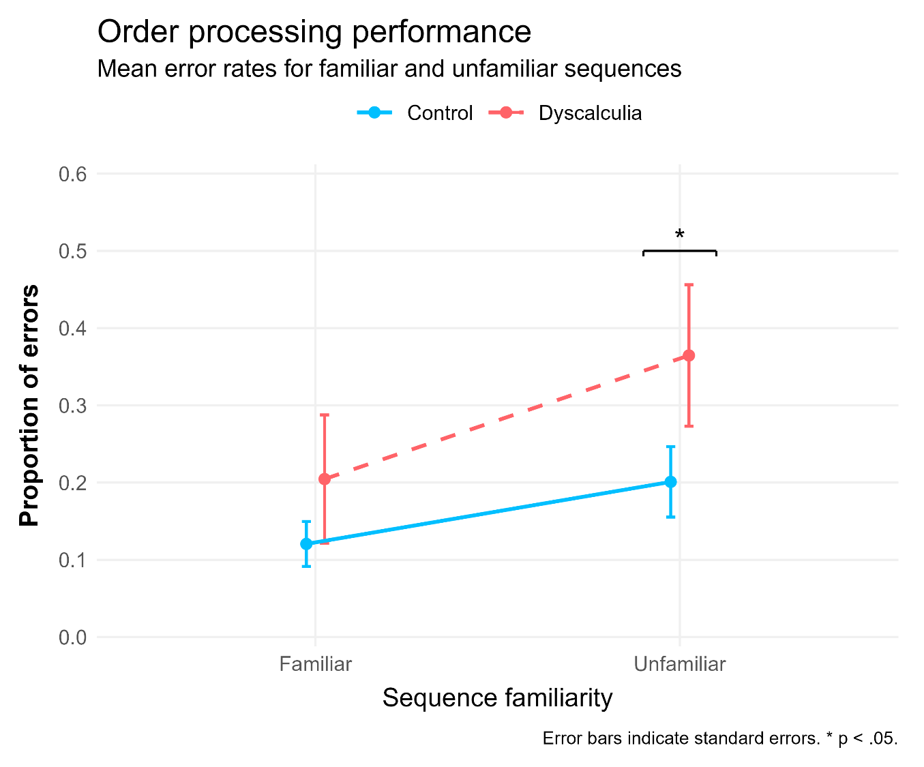
Taken together, these findings suggest that order processing deficits in dyscalculia do appear specific in some way, but precisely what they are specific to remains unclear. Neither the count-list nor familiarity explanations fully account for the current data. Accordingly, much more research is needed to identify precisely what aspect(s) of order processing children with dyscalculia struggle with.
General vs. Specific
An underlying tension in this literature is that some researchers argue that dyscalculia is characterised by a general deficit in order processing, whereas others suggest these difficulties are specific to certain aspects of ordering. Our review argues that this tension may partly reflect the level of detail at which order processing is investigated. In particular, observing impaired performance across multiple tasks does not necessarily mean that all aspects of those tasks are impacted.
For example, if one only considers overall performance on an order verification task, this may suggest a general difficulty with order verification. However, separating performance by sequence type has been shown to reveal that this difficulty is specific to certain sequences, such as non-count-list or unfamiliar sequences12.
Crucially, such specificity can only be detected if researchers actively look for it. For example, Morsanyi and colleagues6 interpreted difficulties across several ordering tasks as evidence for a general order processing deficit. However, it was later pointed out that their order verification findings showed impairment on ascending non-consecutive sequences but not consecutive ones13. Therefore, even within a study suggesting a general deficit, there was evidence of an underlying specificity. Accordingly, it is plausible that similar patterns exist within other ordering tasks but simply remain undetected because performance has rarely been examined in sufficient detail.
We therefore urge caution about concluding that dyscalculia is characterised by a general order processing deficit. Instead, to understand what these difficulties actually represent, future research needs to examine performance more closely across different tasks and sequence types, with explicit predictions about which underlying processes may be affected.
Limitations of the literature
Throughout our review, we identified several areas where the literature remains limited, such as the overreliance on the traditional verification task and the limited consideration of differences between items within tasks. Another overlooked area is the potential influence of affective factors, such as mathematics anxiety.
This is relevant because accumulating evidence suggests that maths anxiety may be associated with impaired order processing performance, including both numerical14 and non-numerical15 forms of ordering. Moreover, children with dyscalculia are thought to be approximately twice as likely to experience high levels of maths anxiety as their typically achieving peers16. Accordingly, it is at least plausible that some of the observed order processing deficits may reflect the influence of affective factors. However, the extent of any such contribution remains unknown as none of the studies we reviewed controlled for the effects of negative emotions.
Conclusions and implications
Overall, we find compelling evidence that children with dyscalculia display some form of difficulty with order processing. However, precisely what those difficulties are, under what circumstances they emerge, and what factors contribute to them remain unclear.
We argue that it is premature—and somewhat unhelpful—to conclude that dyscalculia is characterised by a general deficit in order processing. This is because, when order processing has been investigated at a more fine-grained level, children with dyscalculia appear to display significant difficulties with certain aspects of order processing but no difficulty with other aspects.
We view this specificity as encouraging in the context of translating research into practice. In particular, researchers and educators may be interested in questions such as which order processing tasks and items should be included in screening measures for risk of mathematical learning difficulties, or which aspects of order processing should be targeted for intervention. In this sense, establishing precisely which aspects of order processing are impaired may not only improve our theoretical understanding of dyscalculia, but also contribute to the development of more sensitive and informative screening measures and more targeted approaches to educational support.
In conclusion, therefore, we hope that our work encourages researchers to explore order processing in dyscalculia both across a broader range of tasks and at a higher resolution, taking into account different sequence types. Moreover, we hope that future work pays more attention to how affective factors such as mathematics anxiety, at both the state- and trait-level, may contribute to observed difficulties in order processing performance.
References
1. Lyons, I. M., Price, G. R., Vaessen, A., Blomert, L. & Ansari, D. Numerical predictors of arithmetic success in grades 1–6. Dev. Sci. 17, 714–726 (2014).
2. Sasanguie, D. & Vos, H. About why there is a shift from cardinal to ordinal processing in the association with arithmetic between first and second grade. Dev. Sci. 21, e12653 (2018).
3. Decarli, G. et al. Severe Developmental Dyscalculia Is Characterized by Core Deficits in Both Symbolic and Nonsymbolic Number Sense. Psychol. Sci. https://doi.org/10.1177/09567976221097947 (2022) doi:10.1177/09567976221097947.
4. Träff, U., Skagenholt, M. & Skagerlund, K. Ordinal processing in children with mathematics learning disabilities. Cogn. Dev. 75, 101618 (2025).
5. Slipenkyj, M., Hutchison, J., Ansari, D., Lyons, I. M. & Bugden, S. Ordinal processing differences between children with persistent dyscalculia and typically performing children. Can. J. Exp. Psychol. Rev. Can. Psychol. Expérimentale 79, 195–205 (2025).
6. Morsanyi, K., van Bers, B. M. C. W., O’Connor, P. A. & McCormack, T. Developmental Dyscalculia is Characterized by Order Processing Deficits: Evidence from Numerical and Non-Numerical Ordering Tasks. Dev. Neuropsychol. 43, 595–621 (2018).
7. The Routledge International Handbook of Dyscalculia and Mathematical Learning Difficulties. (Routledge, London, 2015). doi:10.4324/9781315740713.
8. de Freitas, E. & Sinclair, N. The cognitive labour of mathematics dis/ability: Neurocognitive approaches to number sense. Int. J. Educ. Res. 79, 222–230 (2016).
9. Harju, H. & Van Hoof, J. Putting things in order! A systematic literature review on the ambiguity in descriptions, measurement, and terminology of ordinality. Preprint at https://doi.org/10.31234/osf.io/s62jg_v1 (2025).
10. Devlin, D., Dubinkina, N. & Aunio, P. Ordinality and dyscalculia: what do we actually know? Preprint at https://osf.io/preprints/psyarxiv/mp3x5_v1/ (2026).
11. Devlin, D., Moeller, K., Xenidou-Dervou, I., Reynvoet, B. & Sella, F. Familiar Sequences Are Processed Faster Than Unfamiliar Sequences, Even When They Do Not Match the Count-List. Cogn. Sci. 48, e13481 (2024).
12. Devlin, D., Dubinkina, N., De Praetere, E., Sella, F. & Reynvoet, B. The nature of order processing deficits in developmental dyscalculia: The influences of familiarity and the count-list. J. Exp. Child Psychol. 262, 106402 (2026).
13. Hutchison, J. E., Ansari, D., Zheng, S., De Jesus, S. & Lyons, I. M. Extending ideas of numerical order beyond the count-list from kindergarten to first grade. Cognition 223, 105019 (2022).
14. Dubinkina, N., Sella, F., Vanbecelaere, S. & Reynvoet, B. Symbolic number ordering strategies and math anxiety. Cogn. Emot. 0, 1–14 (2023).
15. Skagerlund, K., Skagenholt, M. & Träff, U. Mathematics anxiety and number processing: The link between executive functions, cardinality, and ordinality. Q. J. Exp. Psychol. 78, 101–115 (2025).
16. Devine, A., Hill, F., Carey, E. & Szűcs, D. Cognitive and emotional math problems largely dissociate: Prevalence of developmental dyscalculia and mathematics anxiety. J. Educ. Psychol. 110, 431–444 (2018).

Written By
Centre for Mathematical Cognition
Posted On
Centre for Mathematical Cognition
We write mostly about mathematics education, numerical cognition and general academic life. Our centre’s research is wide-ranging, so there is something for everyone: teachers, researchers and general interest. This blog is managed by Joanne Eaves and Chris Shore, researchers at the CMC, who edits and typesets all posts. Please email j.eaves@lboro.ac.uk if you have any feedback or if you would like information about being a guest contributor. We hope you enjoy our blog!