Beyond the ‘To-Do List’ Curriculum: Why School Mathematics Needs to Focus on Big Mathematical Ideas
In this blog post Professor Colin Foster introduces us to five big mathematical ideas that link all of the school mathematics curriculum. You can read more about Colin’s work at his personal website and at bigmathematicalideas.org.
Introduction
When students come home from school and say what they have been doing recently in mathematics, it can often sound like quite a jumbled mixture. On Monday, they did pie charts, on Tuesday they were adding fractions, on Wednesday they constructed perpendicular bisectors, and so on. To a student, these can feel like separate rooms in a sprawling house, with the doors locked between them. The curriculum becomes a fragmented ‘to-do list’ of disconnected procedures to be rehearsed for the next test and then promptly discarded.
Teachers and researchers know that mathematics does not have to be experienced like that. Mathematics is a deeply connected, coherent web of concepts, in which each becomes more secure and makes more sense when it is more strongly linked to the others. But how do we help students see it that way? How can we move away from an atomised approach to the curriculum and towards one that coheres around a smaller number of key, powerful ideas?
To try to address this, I have launched bigmathematicalideas.org.
The Problem of Fragmentation
Viewing the school curriculum as a long list of granular objectives may appear neat and tidy on a scheme of learning, but it hides the real underlying mathematical structure. When a student learns about multiplying fractions, and later learns about percentage change, they may not see the connections that would make both of these topics easier to grasp and more meaningful.
This fragmentation isn’t just a student problem; it is a pedagogical one. If the teacher’s own mental model of the curriculum is fragmented, their ability to teach for deep understanding will be limited. They might be ‘teaching the topic’, but are they teaching the powerful underlying connections within the mathematics? Beyond school, when a lot of the smaller details will likely be forgotten, it is these deeper foundational ideas that we might hope would remain.
What is a ‘Big Idea’?
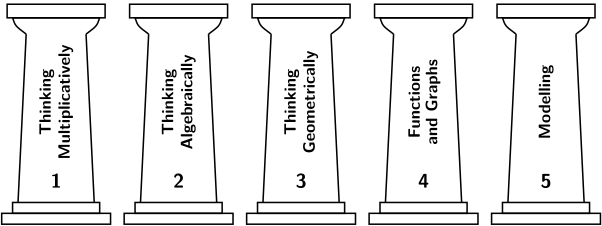
I have structured bigmathematicalideas.org around the five ‘Big Ideas’ shown in the figure. A Big Idea is not a topic title, like ‘fractions’. It is an idea central to mathematics – one that links across numerous different content areas. I show on the website how all the disparate topics within school mathematics rest on one or more of these five pillars.
Making sense of struggles
Difficulties students have across diverse areas, such as fractions, ratio, trigonometry and percentage change, for instance, often relate more to trouble with thinking multiplicatively than to anything specific to those content areas. Teaching these topics when the ‘Thinking Multiplicatively’ pillar is still weak is likely to be stressful and inefficient, and everything is at risk of collapse.
When students struggle with mathematics, on investigation it often turns out they have a relatively small number of real ‘issues’. Indeed, why would they struggle across so many different content areas if there were not common difficulties that were blocking progress? Very often, although the student has encountered the relevant Big Ideas, they have not spent long enough getting really familiar with them. They have never processed them deeply enough to gain the confident fluency that allows them to use the idea across different areas of content.
Investing lots of time on the five Big Ideas aims to put students in the strongest possible position to learn all the smaller ideas much more efficiently and with greater satisfaction and success.
Making use of the ‘Big Ideas’
Each of the Big Ideas captures an essential understanding that a large amount of the school mathematics curriculum builds on. On the bigmathematicalideas.org website, I go into detail, setting out explicitly the most important features of each Big Idea.
In each of the five chapters of bigmathematicalideas.org, I explain the Big Idea, consider the difficulties students typically experience, and suggest how these might be addressed. I then try to show how all the areas of content that build on that idea might be much more efficiently and painlessly taught once the Big Idea is firmly in place. Finally, I suggest how problem solving tasks can be used to delve further into each Big Idea.
You might be surprised at how I have organised the different topics across the site. Everything from the school mathematics curriculum is there, but you may think the topics are ‘all mixed up’. But that is because I have organised them by Big Idea. I have found it really interesting to see how topics that might not usually be thought of as being related can naturally go together.
The website contains hundreds of figures, tasks and references, often including links to lesson plans and full solutions to the tasks. I hope there is something there to interest every mathematics teacher from the trainee to the most experienced.
Let’s stop teaching the ‘to-do list’ and start teaching the Big Ideas!
About the author
Colin Foster is a Professor of Mathematics Education at Loughborough University. His research focuses on the learning and teaching of mathematics in ways that support students’ conceptual understanding.

Written By
Chris Shore
Posted On
Centre for Mathematical Cognition
We write mostly about mathematics education, numerical cognition and general academic life. Our centre’s research is wide-ranging, so there is something for everyone: teachers, researchers and general interest. This blog is managed by Joanne Eaves and Chris Shore, researchers at the CMC, who edits and typesets all posts. Please email j.eaves@lboro.ac.uk if you have any feedback or if you would like information about being a guest contributor. We hope you enjoy our blog!


Centre for Mathematical Cognition
We write mostly about mathematics education, numerical cognition and general academic life. Our centre’s research is wide-ranging, so there is something for everyone: teachers, researchers and general interest. This blog is managed by Joanne Eaves and Chris Shore, researchers at the CMC, who edits and typesets all posts. Please email j.eaves@lboro.ac.uk if you have any feedback or if you would like information about being a guest contributor. We hope you enjoy our blog!