Geoeconomics in Practice: State Power and Trade in the Global Economy — Insights from a Guest Lecture by Klisman Murati
Written by Mtendere Nara Horea (Student of MSc Diplomacy, International Business and Trade)
The Institute for Diplomacy and International Affairs recently welcomed Klisman Murati, Founder and CEO of Pareto Economics, for a timely and thought-provoking lecture on geoeconomics in practice. His message was particular yet expansive: power in the modern world is implemented through economic measures as a through traditional diplomacy and/or military force.
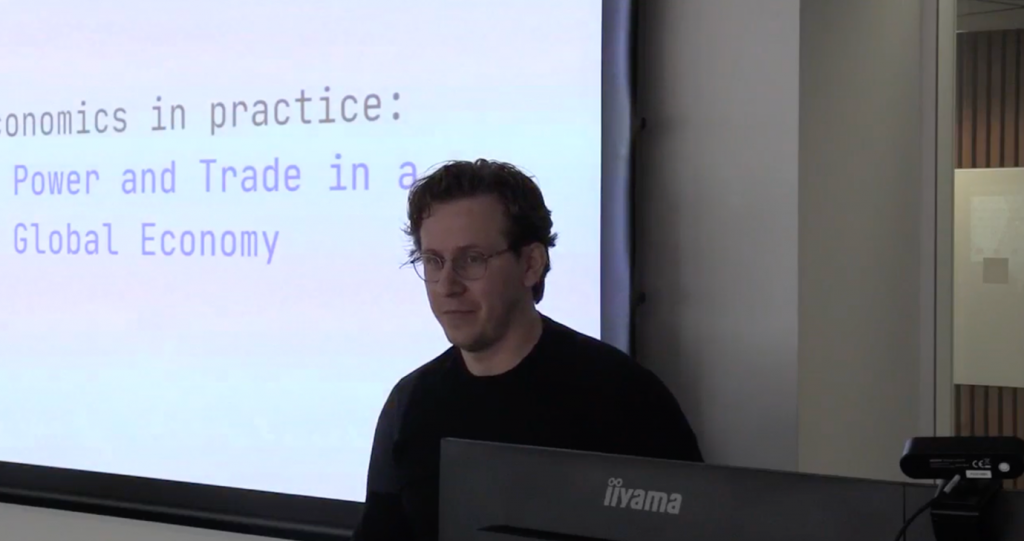
After the presentation, I had the opportunity to ask several questions that further expanded the conversation into how we should think about economic indicators, frontier markets, and career development.
Rethinking GDP: The Most Misunderstood Indicator?
When asked which economic indicator is most misunderstood today, Murati did not hesitate to say: GDP. He described GDP as a highly oversimplified measure. While it captures aggregate economic output, it fails to reflect inequality, distributional outcomes, institutional strength, or long-term sustainability.
A country can present strong GDP growth while experiencing structural instabilities. Without examining inequality, demographic trends, productivity, and governance quality, GDP on its own tells an incomplete story.
Assessing Frontier Markets: Ambition and Execution
On the question of evaluating frontier markets differently from developed economies, Murati reframed how was see frontier markets entirely. They should be assessed based on what they are trying to achieve and the capabilities of them achieving their ambitions.
Rather than focusing on the deficits such as lower income levels, weaker institutions, infrastructure gaps, he emphasized direction and capability. Frontier markets should be assessed based on national ambition, policy coherence, institutional capacity and the executional discipline to achieve targets.
The approach enables a narrative shift from a limitation perspective to a potential outlook while remaining grounded in realism whilst actively implementing.
Compounding Skills: Incentive, Communication, and Humility
When asked which skill compounded most in his career, Murati’s response was striking in its simplicity: understanding people’s incentives and motivations.
Markets move because people make decisions. Policies change as stakeholders apply pressure. Organisations succeed because aligned incentives drive performance. The ability to decode motivations, across governments, corporations, institutions and amongst individuals too is foundational.
He paired this with two reinforcing traits:
- Communication: Clarity of thought is improved through clarity of expression
- Humility: Avoiding ego preserves learning capacity and long-term credibility
For a class preparing to enter diplomacy, finance, and advisory roles, this advice carries purposeful weight.
The Five-Year Vision: Pareto Economics
Looking ahead, Murati articulated an ambitious trajectory for Pareto Economics: to become the most formidable data company driving successful transformation in emerging markets.
This signals, not just growth, but innovation. With deepening analytical capability, refining data models, and positioning the firm for long term contribution at the intersection of policy advisory, strategic intelligence, and economic transformation.
In a world where information is abundant and insight is scarce, structured and multidimensional data analysis gives a competitive advantage.
Final Reflection
The session reinforced how economics is not merely about numbers. It is about power, incentives, institutional design, and long-term positioning.
GDP without distribution is incomplete. Markets without direction are unstable. Talent without humility is unstainable.
The lecture offered a framework not just a perspective. In an era defined by competition and division, those who analyse countries holistically, understand incentives deeply and communicate with clarity will be best positioned to shape outcomes. It’s a reminder that geoeconomics is not just a theory, it is the language of modern governance shaping how states pursue power, manage trade and expand global opportunities.
A recording of Klisman Murati’s talk can be found on the IDIA LinkedIn page.


Loughborough University London
Blogging everything that’s happening at Loughborough University London