Recalibrating the Transatlantic Alliance: Insights from Klaus Welle’s Lecture
Written By Rashane Jude Pintoe (Student of MSc Security, Peacebuilding and Diplomacy)
Amid shifting global power dynamics and mounting geopolitical uncertainty, the foundations of transatlantic relations are being fundamentally reassessed. Long defined by strategic alignment and shared threat perceptions, the relationship between the United States and Europe is now entering a period of recalibration. During this tumultuous period, Loughborough University London organised a timely lecture by the former Secretary General of the European Parliament, Mr Klaus Welle. Titled “Challenges and Opportunities in Transatlantic Relations in the 21st Century”, the lecture was part of the institute’sInside the Profession Series and offered both a diagnosis of current tensions and a glimpse into the future of the transatlantic partnership.
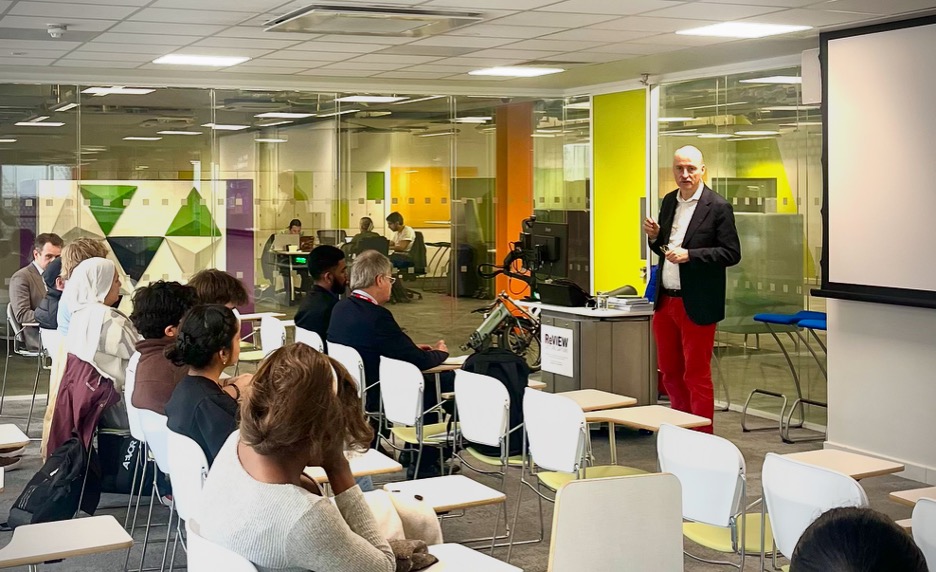
One of the central themes in the discussion was the divergence in threat perceptions between the US and Europe. Mr Welle highlighted that for the first time in over eight decades, the two sides of the pond are no longer aligned in how they prioritise security challenges. He posited that Washington’s strategic gaze is increasingly fixed on China, while Western European states remain primarily concerned with Russian aggression. This divergence thus holds significant implications for alliance cohesion, resource allocation and long-term strategic planning. He suggested that this drift is leading to a slow recalibration of commitments on both sides.
Closely tied to this is the emerging conversation about European strategic autonomy. Mr Welle spoke of the recent remarks made by German Chancellor Friedrich Merz at the Munich Security Conference 2026. He highlighted that Chancellor Merz did not only ask for the operationalisation of the EU solidarity clause in Article 42 but suggested also that Article 42 should become the European pillar of NATO and that that pillar should become “self-sustainable”. This framing is significant. For decades, NATO has functioned with an implicit imbalance – heavily reliant on American leadership and capabilities. This call for a distinct European pillar suggests a shift towards a more self-sustaining model for Europe – something that has become a major discussion, especially after the Greenland debate.
At the national level, changes are also underway that reflect this broader shift. President Emmanuel Macron’s decision to revise France’s nuclear doctrinerepresents one of the most consequential adjustments in decades. While the full implications are still unfolding, the move signals a willingness among key European actors to rethink longstanding strategic assumptions. It also raises important questions about deterrence, signalling, and the future role of nuclear capabilities within Europe’s security architecture.
Perhaps more striking, however, was the discussion surrounding NATO’s Article 5. Traditionally viewed as the bedrock of collective defence, it is now subject to reinterpretation in some policy circles in Washington. Mr Welle highlighted how figures such as Pete Hegseth and Elbridge Colby have suggested that the US may increasingly adopt a secondary, rather than primary, role in responding to threats against European allies. Whether this represents a formal policy shift or simply a strand of strategic thinking remains to be seen. Nevertheless, even the suggestion of such a change introduces a degree of uncertainty that European policymakers can no longer ignore. He stated that US defence strategy is recalibrated on three main priorities. First, having control of the Atlantic – perhaps with a return to the Monroe Doctrine. Second, having control of the Pacific, especially in line with Chinese ship building exercises posing a challenge. And third, a priority that no single country should dominate Eurasia, which is where China’s Belt and Road initiative is a problem for the US.
During the Q&A session, Mr Welle was asked whether the EU’s recent moves towards greater defence integration were reactive – much like a knee-jerk reaction rather than calculated political decisions. His response was candid. Democratic politics, he noted, is inherently constrained by public opinion. While warning signs were visible as early as 2014, particularly following Russia’s actions in Ukraine, the level of public awareness required to drive meaningful policy change only materialised after the full-scale invasion in 2022. In hindsight, what may appear as delay can also be understood as the lag between strategic necessity and political feasibility. Interestingly, Mr Welle also suggested that this shift in American priorities is not confined to any one administration. Even future Democratic governments, he argued, are likely to prioritise domestic spending over expansive commitments to collective defence – further underscoring the importance for the EU to take care of itself.
Another question touched on divisions within Europe itself, particularly in relation to the recent US war with Iran and how some European countries like Spain have refused to support the US. Here, Mr Welle pointed to a structural issue, whereby the incomplete integration of EU foreign policy was to blame. He stated that decision-making remains largely consensus-based, allowing individual member states to act as veto players. Moving towards majority-based decision-making could, in theory, enhance coherence and effectiveness. Yet such reforms face a familiar obstacle, which is that member states are often reluctant to effectively integrate sensitive areas such as foreign policy as it often means ceding a degree of sovereignty to the EU. Integration, as he observed, tends to proceed out of necessity rather than mere ideological commitment.
For the students and staff in attendance, the discussion painted a picture of a transatlantic relationship in transition. For Europe, the challenge lies in balancing greater autonomy with continued cooperation. For the US, it is a question of recalibrating its global role without undermining longstanding alliances. What is certain is that the assumptions that have underpinned transatlantic relations for decades can no longer be taken for granted.


Loughborough University London
Blogging everything that’s happening at Loughborough University London