Lord Sebastian Coe Discusses Sport’s Role in Global Diplomacy with Loughborough London Students
– By Zak Anani, MSc Diplomacy and Sport
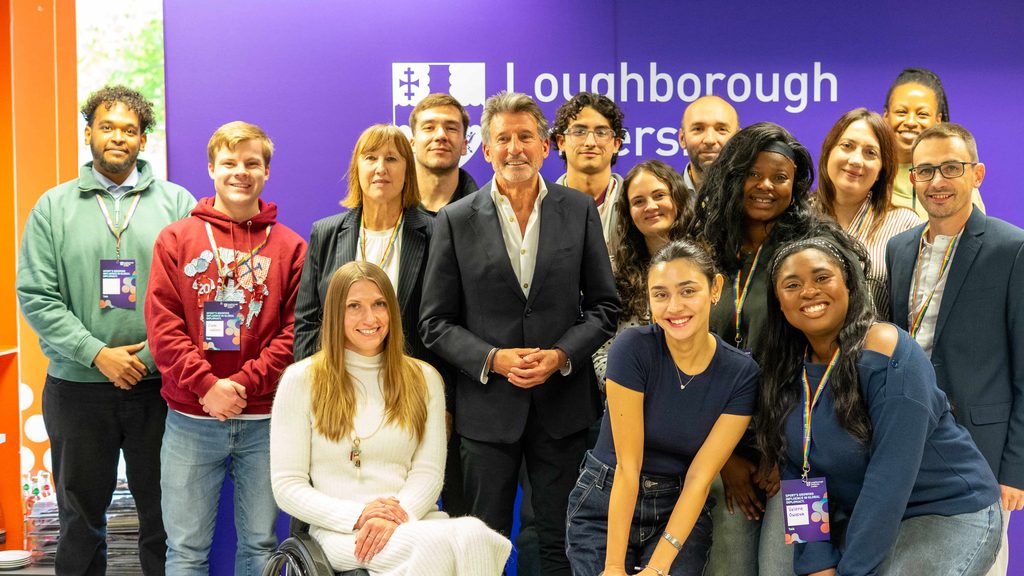
The relationship between politics and sport is a contentious one. Questions about how the two intersect, and whether they can ever be separated, are asked at nearly every major sporting event, often becoming bigger talking points than the sport itself.
Few are better placed to explore this relationship than Loughborough University Chancellor Lord Sebastian Coe. On Friday 9 October, we welcomed Lord Coe to our London campus for a conversation with students, graduates and academics on the sport and diplomacy nexus, hosted by Professor Helen Drake and Dr Holly Collison-Randall.
Lord Coe, who graduated from Loughborough University with a degree in Economics and Social History in 1979, speaks on these topics with particular authority, having worked extensively across both fields. Following a successful middle-distance running career as a two-time Olympic gold medallist, he became an MP for Falmouth and Camborne from 1992 to 1997.
Since then, he has worked at the intersection of sport and politics, notably leading the successful bid for London to host the 2012 Olympic Games. Now, Lord Coe is at the helm of World Athletics, serving his third and final term as president after re-election in 2023.
Has Sport Become More Political?
Among fans of international sport, it is a widely held view that the once pure pastime has become increasingly entangled in the long reach of politics in recent years. Salient controversies surrounding the 2026 FIFA World Cup seem to support this theory. Lord Coe, however, does not, and highlighted his own career as an example of the longstanding connection.
Coe winning gold at both seems one of the few similarities between the 1980 and 1984 Olympic Games, which were among the most contrasting and controversial in the event’s history. The former, held in Moscow, was boycotted by 62 nations following the Soviet invasion of Afghanistan mere months before, and the latter, held in Los Angeles, was boycotted by the USSR in response.
Recalling the events, Lord Coe noted the “comedic extravagance” of the LA Olympics which is widely remembered for its commercial success. As for the boycott of the Moscow Games, he spoke on the unique position he was placed in ahead of the event.
In particular, it was reported that despite the UK not being one of the nations to officially boycott the Games, Coe experienced pressure from then-Prime Minister Margaret Thatcher to support the US-led initiative. Athletes were ultimately given the final say, however, and Coe’s decision to compete led to the iconic 1500m and 800m races won by Coe and
career-rival Steve Ovett that are remembered to this day. “In hindsight it was a good decision,” he told The Guardian in 2006.
This is one of the many examples Lord Coe cited when explaining how the relationship between sport and politics extends much further back than many believe. He also contrasted the Nazi use of the 1936 Games with Tommie Smith and John Carlos’ historic Black Power Salutes in 1968 to indicate how sport can act as a political stage.
The relationship extends further still. Ancient Greek city-states would advertise their victory at the Olympic Games as a symbol of their overall superiority, a sign of the power sport has when it comes to winning hearts and minds.
The Legacy of London 2012
As an athlete, Lord Coe’s Olympic success unfolded against a backdrop of political controversy. But off the track, how has he fared in driving positive change as a policymaker?
The answer is that he has done so particularly well, notably through his position as chairman of the Olympic bid for London 2012, which has since been highly acclaimed for its legacy and the impact it had on the East End of the capital.
“The Olympics changed the way the world saw London,” emphasised the university’s Dean, Aidan McGarry in his opening remarks for Lord Coe, though the change was felt not only on an international level, but also at a local one.
The audience at Loughborough London will support this idea. To them, the legacy of London 2012 is not abstract. Loughborough London occupies part of what was the Games’ Press and Broadcast Centre, a building Coe joked he had spent many nights sleeping in on a camp bed. It is a stark transformation. As Coe recalled, and as local residents will remember, the area was once better known for ‘Fridge Mountain’, a dumping ground for industrial waste.
Lord Coe, having trained in Hackney while representing Haringey AC during his running career, described the area as “a part of London that economics left behind,” but suggested it was this context as a regeneration project that helped bring the Games back to the city after a 64-year wait.
The opportunity was such a great one that bidding for the Games became, to his memory, one of the few decisions that received complete political unanimity. So true was this the case that Lord Coe recalled speaking to then-Prime Minister Tony Blair to suggest that the IOC (International Olympic Committee) president not only meet with him as part of the traditional organising process, but also with other major political figures in the lead-up to the Games.
Now, sites such as the East Village, Loughborough University London and Stratford station all represent the successful legacy that the 2012 Games left behind – features that made this part of East London a travel hub and brought increased investment to what is a deprived area of one of the world’s most famous cities.
Sport and Politics Today
The positive effects of London 2012 are felt to this day, but what of the wider issues that face Lord Coe’s current roles?
Prompted by an audience question, one concerns the financial empowerment of athletes – an issue Lord Coe has been at the forefront of in recent years. This comes through his role as President of World Athletics, where in 2024 the organisation declared that it would award prize money to its athletes at the Olympic Games. “Financial welfare [for athletes] is overlooked,” he said, with World Athletics becoming the first international federation to make this landmark decision.
Lord Coe was then asked by a student about the attention given to sport within governmental bodies, to which he responded that, in some respect, he has greater political influence now as President of World Athletics than he did as an MP.
That influence brings with it difficult political decisions, such as whether to exclude Russian and Belarusian athletes from sporting events. When asked about sportswashing, he argued that roles like his as president of World Athletics come with a responsibility to ensure host nations uphold human rights, and noted how dismayed he is that the United Nations does not have a director of sport.
Responding in depth to questions from the student audience, Coe highlighted the need for a more “cross-departmental” approach to increasing participation, as well as the challenge of climate change in sport.
Drawing on his extensive experience as an athlete, MP, businessman, leader of the London Olympic bid, and President of World Athletics, Coe offered students valuable insight into the complex nature of sports governance, politics, and diplomacy, and a reminder of how the politics of sport is not entirely new.


Loughborough University London
Blogging everything that’s happening at Loughborough University London