Reimagining Fractions using an Augmented Reality “Magic” Spiral Staircase
In this blog post Dan O’Brien, a doctoral researcher at the Centre for Mathematical Cognition, tells us about a project he has been working on and a study for schools to get involved with. If you are interested in taking part in this exciting project with your Key Stage 3 (11-14 year olds) then please get in touch here.
The problem
Just when young children get used to – and enjoy – working with whole numbers, they are taught that other numbers exist in-between them, called fractions. Yet these new numbers are a bit special! While they consist of a whole number in both the numerator and denominator, a common misconception amongst learners is that each can be considered in isolation – without reference to the other. For example, just becauseSuch confusion is an example of “whole number bias” – where we try to apply what is always true for whole numbers to fractions, even if it leads to errors. This may contribute to the notorious difficulty many learners have with fractions (Ni and Zhu, 2005). Research also suggests this may also be exacerbated by incoherence between the visual representations commonly used to teach fractions (Foster, 2022).
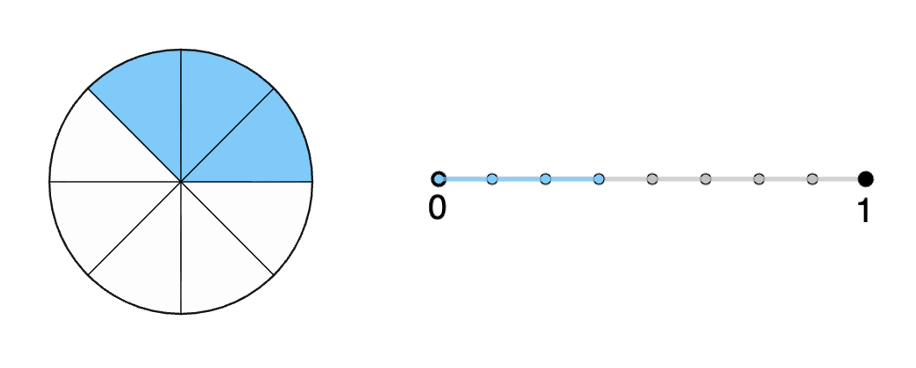
For example, children are typically introduced to fractions using a “pizza” model (e.g. Fig. 1) – where the shaded slices are counted as parts of a whole number of slices. Such models may reinforce whole number bias by emphasising the numerator and denominator rather than the relationship between them (Tian et al., 2021). Number lines, on the other hand, are widely recommended for representing both whole numbers and fractions (e.g. Fig. 1). Among their many benefits, number lines integrate both types of number alongside others (Siegler and Lortie-Forgues, 2014).
The (proposed) solution
But how can these two very different representations be reconciled? I have been working on just this problem: integrating both into a single, coherent 3D model. My solution is to use a spiral staircase which you can see in Fig. 2. In Augmented Reality (AR), this representation can be viewed in different orientations (Fig. 3). When this is viewed from ‘above’, it resembles a pizza; but when viewed from the side, its centre pole is a number line. The spiral design is also able to clearly represent fractions greater than 1 or less than zero – and different colours can be used for successive integers in either direction (as with the representation of in Fig. 3).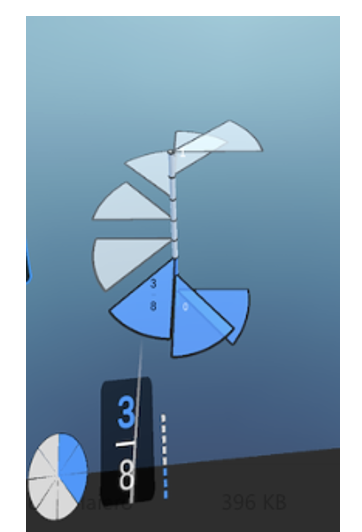
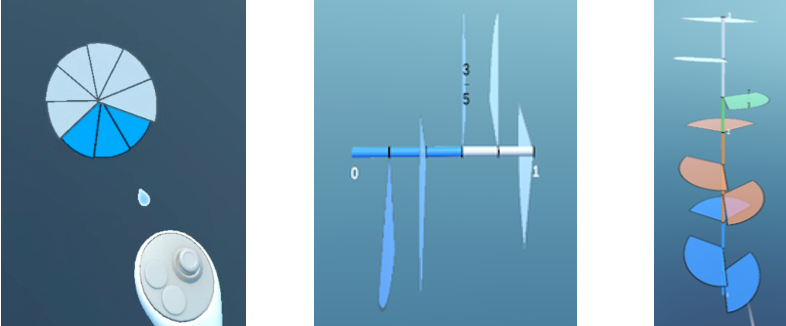
Figure 3. Pizza and number line representations using different orientations of the spiral.
International Collaboration: Developing and Testing the Prototype App
Through collaboration with an expert team at the Leibniz-Institut für Wissensmedien (Knowledge Media Research Centre) in Tübingen, Germany, the spiral concept has now been developed into a prototype app that can be experienced via the Meta Quest 3 headset. It has since been tested with focus groups in Germany, the UK and Finland – where it was also presented at the 49th Conference of the International Group for the Psychology of Mathematics Education (PME 49) in Helsinki – (see Fig. 5).
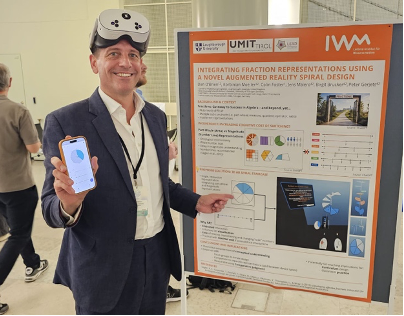
Figure 5. Demonstrating the smartphone and Meta Quest 3 apps at PME 49.
So far, focus group feedback from schoolchildren, mathematics education researchers and student teachers has provided triangulated perspectives on the prototype’s effectiveness, along with new ideas to enhance future versions. Participants consistently found the spiral concept to be intuitive; one even said that it helped ‘to “feel” the math more deeply’. Among future design tweak suggestions are: usage of a back button to revisit and change answers; making the fraction numbers physically closer to the spiral rather than being pegged to the controls (to reduce split attention effects); and having more intuitive controls such as sliders rather than joysticks.
Next Steps – Calling all KS3 Maths Teachers!
Having completed these first evaluation rounds, I am working with IWM Tübingen to incorporate focus group feedback into the next iteration of the app’s design. This version will be tested next month with teachers and researchers at the 10th British Congress of Mathematics Education (BCME 10) – the UK’s largest mathematics education conference.
Crucially, however, the app is now ready to be introduced into real-world secondary classroom settings. The corresponding lesson plans will be trialled with Key Stage 3 mathematics students and developed with their teachers. Accordingly, all Key Stage 3 mathematics teachers are invited to participate in lesson trials with their own classes: if you are a teacher and interested in doing so, please register your interest at this link: AR Number Line Trial Lessons.
Ultimately, I intend to feed all insights gained from these empirical studies into a prototype design that can be compared experimentally with the pizza and number line representations already in common use. Should such comparison prove favourable, this could have implications for classroom practice. Moreover, if AR technology becomes as cheap and widely available as the calculator did in the 1980s, those implications could be far-reaching.
If you are a teacher in a UK secondary school and would like to work with Dan on this exciting project, please get in touch with him via this link. Dan would be able to come into your school to take some classes and demonstrate the tasks in the visualisation using the Meta Quest 3 headsets.
References
Foster, C. (2022). Using coherent representations of number in the school mathematics curriculum. For the Learning of Mathematics, 42(3), 21–27. https://www.jstor.org/stable/27239246
Ni, Y., & Zhou, Y. D. (2005). Teaching and learning fraction and rational numbers: The origins and implications of whole number bias. Review of Educational Research, 75(1), 1–52. https://doi.org/10.1207/s15326985ep4001_3
Siegler, R. S., & Lortie-Forgues, H. (2014). An integrative theory of numerical development. Child Development Perspectives, 8(3), 144–150. https://doi.org/10.1111/cdep.12077
Tian, J., Bartek, V., Rahman, M. Z., & Gunderson, E. A. (2021). Learning improper fractions with the number line and the area model. Journal of Cognition and Development, 22(2), 305–327. https://doi.org/10.1080/15248372.2021.1890603

Written By
Chris Shore
Posted On
Centre for Mathematical Cognition
We write mostly about mathematics education, numerical cognition and general academic life. Our centre’s research is wide-ranging, so there is something for everyone: teachers, researchers and general interest. This blog is managed by Joanne Eaves and Chris Shore, researchers at the CMC, who edits and typesets all posts. Please email j.eaves@lboro.ac.uk if you have any feedback or if you would like information about being a guest contributor. We hope you enjoy our blog!


Centre for Mathematical Cognition
We write mostly about mathematics education, numerical cognition and general academic life. Our centre’s research is wide-ranging, so there is something for everyone: teachers, researchers and general interest. This blog is managed by Joanne Eaves and Chris Shore, researchers at the CMC, who edits and typesets all posts. Please email j.eaves@lboro.ac.uk if you have any feedback or if you would like information about being a guest contributor. We hope you enjoy our blog!