Bridge Over Troubled Waters: IDIA Students Visit the IMO
By IDIA student Ahmed Waleed Isameldin Mohamed
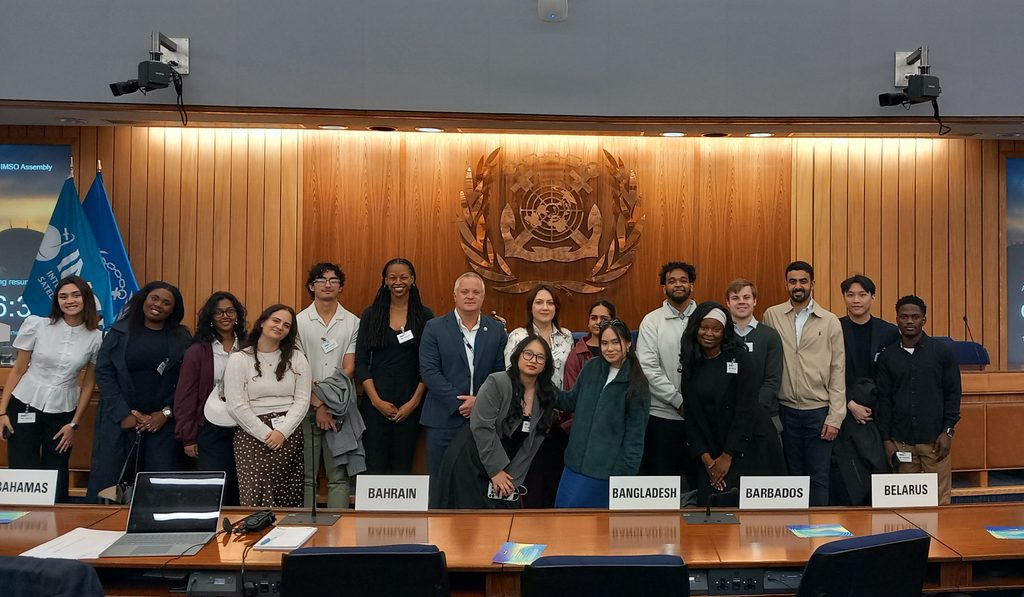
Since the newest in a series of conflicts in the Middle East began on 28 February 2026, shipping in and around the Strait of Hormuz has come under sustained attack. By late August, the International Maritime Organization (IMO) had verified at least 70 attacks on merchant ships, and 19 seafarers had been killed. The IMO’s Secretary-General, Arsenio Dominguez, has taken the issue to the UN Security Council. Against this backdrop, on 14 October 2026, Master’s students from the Institute for Diplomacy and International Affairs (IDIA), accompanied by Dr. Tatevik Mnatsakanyan, visited the IMO’s London headquarters, within the scope of their course Diplomacy in the Digital World. They were received and hosted by Michael Guy, IMO’s External Relations Officer, for a tour around the Headquarters and a talk about the Organisation’s history, current work and challenges.
The IMO in Brief
The IMO is a UN Specialised Agency for the safety and security of shipping, the marine environment and seafarers’ welfare. Its aviation counterpart. The IMO, being relatively small compared to other UN agencies, performs its main work at the London Headquarters, with seven regional offices handling technical cooperation. The Assembly meets every two years; five committees meet yearly, with sub-committees beneath them, with the working languages being English, French & Spanish. What distinguishes it from other UN agencies is that the budget is set in London, not New York. Each member state contributes according to its fleet’s gross registered tonnage; therefore Liberia and the Marshall Islands are among the largest contributors.
Security at Sea
As noted by our host External Relations Officer Mike Guy, the Secretary General often briefs the Security Council on Hormuz, the latest briefing he attended personally having taken place in April 2026. By late August, up to 400 ships and about 6,000 seafarers had been unable to leave the Gulf. In July, the IMO Council reaffirmed the right of transit passage, saying passage should be free of tolls, highlighting the mission at the IMO’s core: the safety and welfare of seafarers.
Who does the Diplomacy?
Mr. Guy explained that a country’s permanent representative is often but not always its ambassador or high commissioner to the Court of St. James (also accredited to the IMO).
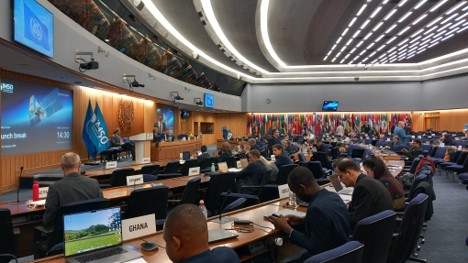
The IMO has no say in who is sent: the head of state writes to the Organisation, and a formal accreditation process follows. Because these are diplomatic postings, turnover is constant. There was a question on whether there is an observed trend of increasingly sending career diplomats, potentially with some expertise in marine affairs. However, we heard that, Ambassadors rarely arrive with deep knowledge of maritime regulation, which is why alternate permanent representatives matter.
States are not the only actors in the room: 98 non-governmental organisations (NGOs) hold consultative status, each with a representative. They attend meetings, build relationships with delegations through open dialogue and trust, and can put forward proposals of their own. Players in the industry are also represented through bodies such as INTERTANKO, the association of independent tanker owners, on the design of oil tankers, while groups such as WWF (Worldwide Fund for Nature) bring specialist knowledge the IMO is keen to hear.
The Limits of International Law: Rulemaking, not Enforcing
A student at IDIA asked what the IMO can do if a state openly breaks the rules. The answer was “nothing at all”. Indeed, as elsewhere in relation to International Law, here IMO has no direct mechanisms or power to enforce the compliance of the rules states have agreed to. This makes IMO’s central premise and principle of consensus even more important as enforcement ultimately sits with states: an understanding achieved through consensus holds more chance.
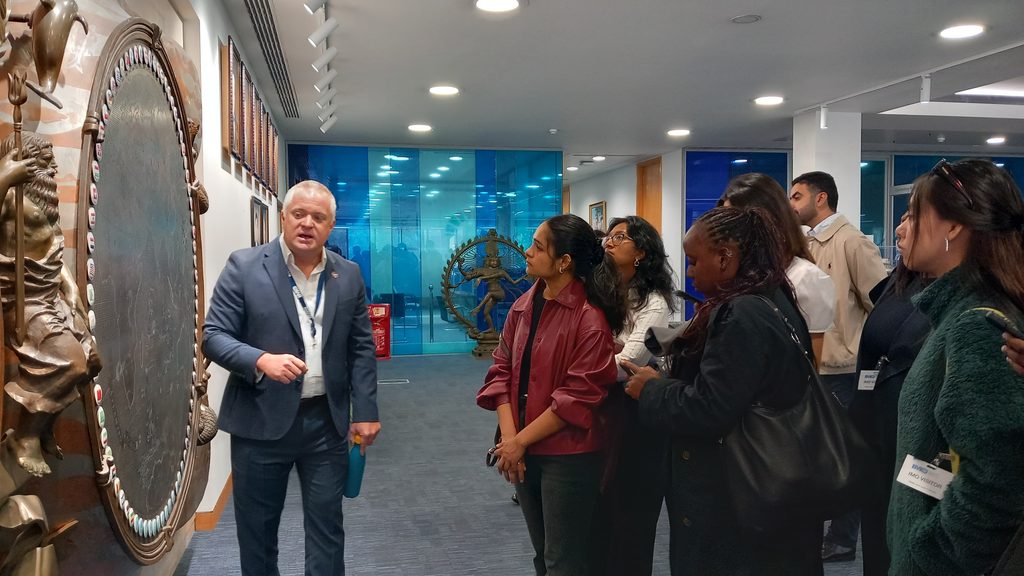
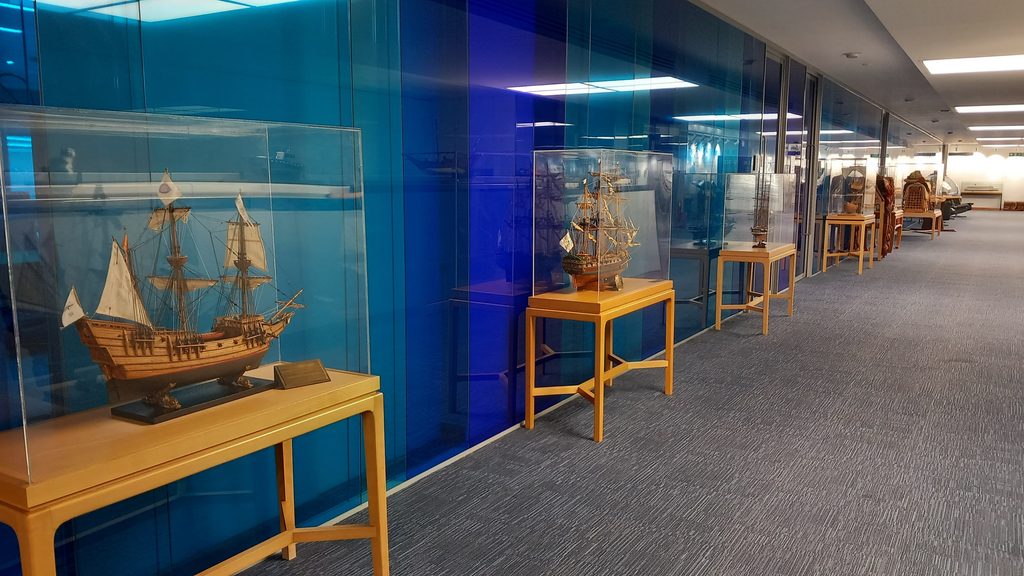
As part of the tour, we visited the lounges and corridors that the diplomats often negotiate in—through “corridor diplomacy” and outside the formal halls—to achieve such understanding. These lounges and corridors were simultaneously acting as archival displays representing different moments of the Organisation’s history, as well as reminding of the importance of symbolism in diplomatic communication. We explored and heard about large and small diplomatic gifts from member states including various ship models, gifts with cultural significance and local artwork. The IMO values these lounges and corridors, as symbols of decades of navigating the sensitive waters of negotiating across cultures.
The Net Zero Framework
Nowhere can the case for consensus be made clearer than in the Net Zero Framework. It is a new set of international regulations aimed at reducing greenhouse gas emissions from ships, in line with IMO’s 2023 Greenhouse Gas Strategy, and more broadly part of IMO’s commitment to the UN Sustainable Development Goals. It aims to set a legally binding global standard requiring ships to gradually reduce their ship fuel and introduce a pricing mechanism for such emissions. These were approved as regulations under amendments to the already existing International Convention for the Prevention of Pollution from Ships. However, as a Framework, to become legally binding, a consensus is required. This is the major challenge at the moment.
In April 2025, the Framework draft was approved in principle by the Marine Environment Protection Committee. However, the formal legal adoption due at an extraordinary session in October 2025 was not successful and discussions have adjourned until later in 2026. We heard about the pressure exercised by powerful members—the United States officially opposing the framework, urging other countries to reject it and also threatening retaliation such as visa restrictions, port measures and sanctions against countries that support the framework. What happened in the committee rooms and corridors of IMO is indicative of the more general power hierarchy characteristic of international negotiations, norms setting and power inequality. In corridor diplomacy, most likely certain ‘Interesting tactics’ were employed that week in October 2025, with delegates being influenced, and positions shifting over the five days. On the final day, a motion to adjourn for a year passed. For an organisation built on consensus, this episode demonstrated that unequal distribution of power and influence is felt greatly in its norm production.
Recording & Messaging
In response to a question on whether delegates are discouraged from publicizing (e.g. through social media posts or interviews) the internal discussions taking place during negotiations, we heard that they advise them not to, although the IMO cannot formally forbid this. What has changed is the audience: meetings are now recorded live, and the Secretariat follows social media closely to make sure what is said about the IMO is accurate. These changes came with the Covid Pandemic. Remote participation is now part of how the IMO works. It also raised an unexpected worry among diplomats: if a meeting can be attended from a capital, a posting in London might start to look unnecessary.
The Next Generation
The visit ended at the Maritime Knowledge Centre, the IMO’s library, where research interns showed how far technology now shapes the IMO’s agenda. Researchers from across the world were studying a variety topics—from cybersecurity of autonomous ships to the laws of the sea; from marine engineering to life at sea, to evolving digital skills integration. For the IDIA students, who just finished their module titled “Diplomacy in the Digital World”, the point was clear: the IMO is adapting its own diplomacy to digital tools while writing the rules for a digitising industry.
Leaving the IMO, it was hard not to notice how much of its work depends on what happens outside the main hall. Consensus is slow, and it rests on trust between delegations that change every few years. The IMO writes rules that ships everywhere are expected to follow, yet, it can do “nothing at all” when a state openly ignores them. Its strength comes from achieving consensus, and this year the model has been tested twice, at sea in the Gulf and in the Headquarters in London.
The tour left a clear impression: the IMO’s rules are formally made by member states; and yet in reality they are shaped by transport officials, industry associations and lobbyists influencing own governments, NGOs and transnational advocacy groups, and the staff who support them. The harder question is who still lacks a seat. The people on the ground those most affected by the seafaring rules and those suffering from the consequences of greenhouse gas emissions and other forms of pollutions have limited mechanisms to be heard: through civil society in home countries or through transnational NGOs active within the IMO. It remains to be seen how this power-imbalance may shift.


Loughborough University London
Blogging everything that’s happening at Loughborough University London