DRN2026 Drawing as Storytelling: Narrated Memories
Online event: Wednesday 29th April 2026
Tickets: https://www.tickettailor.com/events/drawingresearchgroup/2143687
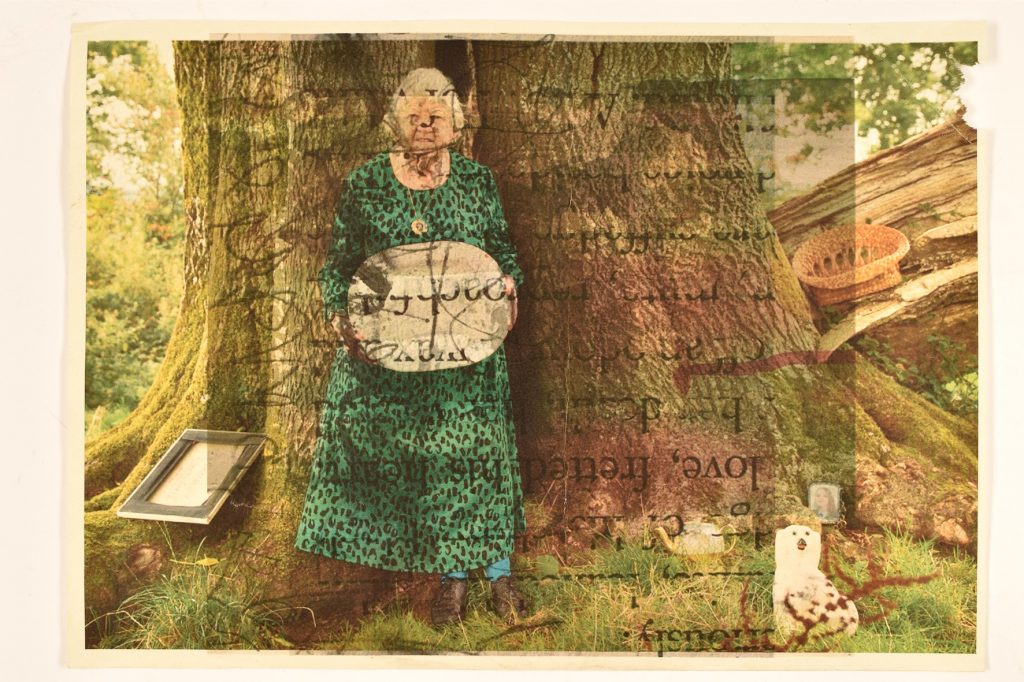
Narrated Memories is the first in a series of online events in collaboration with the Storytelling Academy at Loughborough University, which explore the relationship between Drawing and Storytelling. Drawing begins where words cannot reach, and storytelling begins when images ask to be read. This first panel brings together artists and researchers exploring the theme of narrated memories.
Lucy Brennan Shiel’s presentation will consider a story that began with a letter from her Irish mother sent to Brennan Shiel in the UK. The letter became a large drawing, which was explored through Bracha Ettinger’s matrixial theory, a theory of the feminine. The drawing was initiated by Brennan Shiel’s mother’s writing which subsequently inspired the drawing. The drawing can be encountered as a psychic ‘borderspace’ explored through partly scripted and partly improvised storytelling. It’s a re-encountering of Brennan Shiel’s mother. It includes a recent photographic process subsequently layered through the photocopier with drawing processes. That ‘uncopying’ process forms part of the story which aims to navigate the complex layers of re-engagement that were interrupted by colonial restructuring in Ireland and subsequently through Irish Catholicism, which became the vehicle of Irish nationalism. Meanwhile, Irish women fell prey to both and like Brennan Shiel, emigrated. According to Irish feminist writer Geraldine Meaney ‘a history of colonisation is a history of feminisation’, but where does that leave the identity of Irish women? Using James Joyce’s Ulysses as a literary and ancestral reference point and a site of feminist intervention in the character of Molly Bloom, the presentation will explore exile, loss, and blind spots in retraversing the site of ‘the mother’.
Janice Nadeau’s presentation will explore the relationship between drawing and storytelling through Mémoires de maisons, a practice-based research project in which writers and poets are invited to narrate memories of a former home. The research examines how drawing, understood as a polymorph process and an act of bricolage, intervenes in storytelling by collecting fragmented memories and filling gaps created by narrative omissions. The ongoing project is based on private interviews with writers and poets from Quebec. As their memories unfold, the researcher produces drawn notes in an immediate and urgent mode, comparable to figure drawing, where one gathers as much information as possible before the subject changes pose. This phase results in spontaneous drawings composed of accumulations of words, sketches, crossings-out, and collages, reflecting the intensity of listening to an embodied voice while drawing in real time. Narrated memories emerge in fragments rather than as complete or spatially organized accounts. Between these fragments lie absences that drawing can activate—not to recover historical truth, but to intervene in the narrative itself. Adopting the position of the bricoleur (Lévi-Strauss), who works with what is available, the drawer selects elements, triggers free association (Taylor), and invents story fragments to reconstruct a remembered house. The narrator’s style directly shapes this process, requiring constant adaptation as new spatial elements emerge. By prompting questions and clarifications during the interview, drawing operates as a reflexive tool (Schön) that reshapes the narrative, challenges the traditional subordination of drawing to text, and transforms storytelling through a new mode of expression.
Yige Bao’s presentation will explore how drawing, when approached as a thinking and sensing process, can dissolve the boundaries between image and text, forming a hybrid language rooted in bodily experience. Informed by autoethnographic methodology and posthumanism theory, Bao’s practice investigates how drawing functions not as representation, but as a trace: a residual movement of the body, memory, and affect. Building on theories of drawing as performative, time-based, and processual, this presentation approaches drawing as a form of embodied storytelling. Drawing is not simply a visual outcome but an active thinking process; it is a gesture in time, a trace of bodily movement, attention, and sensation. Rather than aiming for representation or resolution, drawing in this context allows for repetition, erasure, hesitation, and disruption, which better reflect the fragmented and layered nature of memory and identity formation. Within Bao’s autoethnographic practice, drawing does not illustrate written narratives but coexists with writing, forming an intermedial space in which verbal and visual elements shape one another. This visual–verbal interstice invites alternative forms of narration that are non-linear, fragmentary, and affective, enabling the articulation of experiences that resist discursive capture.
Biographies
Lucy Brennan Shiel is a mixed media inter-disciplinary Irish artist working in the space between Ireland where she grew up and England where she now lives. Her research interests are a Drawing, Feminism and Ulysses (1922) a novel by Irish writer James Joyce. She has been exploring how drawing activates integrated narratives and the potential to re-member memories or imaginings when encountering others and our potential to imagine differently through integrated storytelling.
Janice Nadeau PhD is a professor at University of Quebec in Montreal (UQAM) École de design (Canada). Her practice explores memory and graphic space through drawing, illustration, and animation. She has illustrated award-winning books and directed animated films, including Harvey (2023), selected in over 130 festivals and recipient of 17 awards.
Yige Bao, from China, is a visual artist living in the UK. PhD doctoral researcher at the School of Social Sciences and Humanities at Loughborough University, current research interests focus on Feminism, Posthumanism, and female reproductive alienation.


DRAWING RESEARCH NETWORK
hosted by TRACEY at Loughborough University